Thursday, 22 August 2013

Queenship of Mary


As an American moving to England in very early 1985, (although I had visited it before that in 1980 for a long visit), I was taken off guard one day when a Catholic man said to me, "Well, do you have a personal love for the queen?"

I had to stop a second and gather my wits. I said to him that as an American Catholic, I only had one queen and that she is the Blessed Virgin Mary, Queen of Heaven and Earth. We had an interesting discussion on the nature of queenship. My loyalties to Mary, Our Mother, were and are, of course, deep and abiding. To realize, after I moved to England, that I had to adjust to some sort of loyalty to a contemporary queen was interesting.

As a conservative, traditional Catholic, I had no problem, when I had residency in England,  honouring the Queen of Great Britain, but this honour was not the same as that which I give to Mary, as the present queen does not have allegiance to the Catholic Faith, nor is she the Mother of God, or even an earthly representative of a Catholic state.

We actually have a personal relationship, through Christ, with Mother Mary, Queen. We can speak to her in prayer and ask her intercession. And, although, I actually represented the Catholic Church in London at two things which were attended by the Princess Royal and aristocrats, I most likely will never be introduced to the present Queen of Great Britain in order to beg her for favours, such as citizenship, for example.

I have met and was introduced to one prince, in Rome, a long time ago, and other aristocrats in other places, but when one says "queen" to me, I think firstly of the Queen of my heart, the Theotokos.

If I were a citizen of Great Britain, of course, the present queen would have my allegiance, as due to her state.

This comment started a process of thought on the Catholics during the reign of the Protestant kings and queens of England--how they must have understood queenship clearly, but with struggles.

To the Queen of my heart, I give loyalty, allegiance, honour, praise, and love.

Today, I am reminded that at this time, I only have one queen, and I hope she takes me as her lowliest servant, a mere kitchen maid, or lowly scribe, to serve her now and forever.

My queen is alive and lives in heaven, body and soul. Amazingly, I can shout, "Long live the Queen".

Friday, 16 August 2013

By The Press Divided


Between 1983 and 1985, a series on the BBC revealed the treachery among family members during the English Civil War. Being a huge fan of Tim Bentinck and Robert Stephens, I watched the entire first series and second series; the title was By the Sword Divided.

Now, the great gulf of emotions and political allegiances of the Lacey Family are highlighted in this series.
The entire, horrible truths of family members betraying family members jolts one into reality. When I watched it in those years, I knew this type of hatred for good and for truth would happen again and split families forever. To me, the series was prophetic.

The series emphasizes the deep seated religious convictions of both the Parliamentarians, or Puritans, and the Anglican and Catholics, the Royalists. The family as depicted is fictional, although there are Laceys in English history. One could change the name to Langton, Grenville, Throckmorton, Hopton, Noel, or even Villiers and understand the divisions in families across England those ten years, many divisions which have lasted to this present day in the families which have survived.

Modern historians read the Civil War as class warfare of the lower and growing middle class against the aristocracy, which is revisionist, Marxist history.

The reality of religion becomes less important to these Marxists, who judge all wars as based on money and status. 


Not so. When I watched the series, and having studied the Civil War as a history major, my first degree, I was shocked at the hatred within families totally founded on Calvinism or Anglicanism, or Roman Catholicism. Having visited some of these places where the battles were fought, and realizing how many Catholics were involved in supporting the Royalist cause, I began to see that the real meaning of the Civil War was not the rising middle class and their hold over Parliament, which, of course, aided the Calvinist cause, but the absolute hatred of the established Church and the Monarch, who represented that Church.

As I watched the series so long ago, my thoughts were on the splitting of the Catholics in America and England into two classes: the Obedient Ones and the Rebellious Ones. Those who try to be obedient to the Catholic Church form a small minority as against the majority who compromise and deny the necessity for daily conversion.

Catholics who refuse to be a sign of contradiction in the world have capitulated to the secularists.


Do not live in la-la land thinking those who love Rome and Her Teachings will not see the day when families are torn apart in the name of religion, false and true.

It has already happened to some of us. I also recommend this book below, which I have in a box in storage in Illinois.

The fight now is in the press, in the liturgy, in the lack of leadership both in the clergy and laity. We have only to blame ourselves.  I see bloggers and other journalists taking sides-the Obedient vs. the Rebellious. Those among us who insist on reading and writing own opinions or new age, or protestant interpretations of Catholic Teaching, are continuing the Civil War in England and adding to the coming splits,which will be deeper and more tragic.


Thursday, 15 August 2013

Litany of Our Lady


V/ Lord, have mercy.
R/ Lord, have mercy.

V/ Christ, have mercy.
R/ Christ, have mercy.

V/ Lord, have mercy.
R/ Lord, have mercy.

V/ Christ, hear us.
R/  Christ, graciously hear us.
V/ God, the Father of Heaven,
R/ have mercy on us.
V/ God, the Son, Redeemer of the world,
R/ have mercy on us.
V/ God, the Holy Spirit,
R/ have mercy on us.
V/ Holy Trinity, One God,
R/ have mercy on us.


R/ for ff: pray for us.
Holy Mary,
Holy Mother of God,
Holy Virgin of virgins,
Mother of Christ,
Mother of divine grace,
Mother most pure,
Mother most chaste,
Mother inviolate,
Mother undefiled,
Mother most amiable,
Mother most admirable,
Mother of good counsel,
Mother of our Creator,
Mother of our Saviour,


Virgin most prudent,
Virgin most venerable,
Virgin most renowned,
Virgin most powerful,
Virgin most merciful,
Virgin most faithful,
Mirror of justice,
Seat of wisdom,
Cause of our joy,
Spiritual vessel,
Vessel of honor,
Singular vessel of devotion,
Mystical rose,
Tower of David,
Tower of ivory,
House of gold,
Ark of the covenant,
Gate of Heaven,
Morning star,
Health of the Sick,
Refuge of sinners,
Comforter of the afflicted,
Help of Christians,


Queen of Angels,
Queen of Patriarchs,
Queen of Prophets,
Queen of Apostles,
Queen of Martyrs,
Queen Confessors,
Queen of Virgins,
Queen of all Saints,
Queen conceived without original sin,
Queen assumed into heaven,
Queen of the most holy Rosary,
Queen of Peace,


Lamb of God, who take away the sins of the world,
R/ spare us, O Lord,

Lamb of God, who take away the sins of the world,
R/ graciously hear us, O Lord.

Lamb of God, who take away the sins of the world.
R/ have mercy on us.

Pray for us, O holy Mother of God.
R/ That we may be made worthy of the promises of Christ.

 Let us pray. Grant, we beg you, O Lord God, that we your servants, may enjoy lasting health of mind and body, and by the glorious intercession of the Blessed Mary, ever Virgin, be delivered from present sorrow and enter into the joy of eternal happiness. Through Christ our Lord. R/ Amen.

Wednesday, 14 August 2013

The Feast of St Maximilian Kolbe


'Greater love has no man than this, than to lay down his life for his friends.' (St John 15:13)

So it is that today, 14 August, we celebrate the Feast of St Maximilian Kolbe, Martyr of Auschwitz, model of Franciscan poverty, true son of Mary, Priest who sought only the Heart of Jesus, exemplar of Christian self-sacrifice and advocate for the Faithful in Heaven.

With Blessed Titus Brandsma, with St Teresa Benedicta of the Cross and others, Maximilian Kolbe shines as a beacon of hope in the horror of the concentration camps established by the Nazi regime in the century marked by bloodshed, fraternal hatred and totalitarian systems that reduced mankind to rubble.

The world disputes the holiness and charity of some Saints, but before the example of St Maximilian Kolbe, the world falls silent in the story of his sublime act of self-sacrifice. The world disputes the holiness of Pope Pius XII, but can say nothing of reproach for the Franciscan friar who stepped in place of a Jew who was condemned to die, saying, "He has a wife and family, I am a Catholic Priest, take me instead." His reputation will never tarnish or fade. With one act of love he sealed his fate as an icon of Christian love, fidelity to Jesus, lover of the Jewish people and unique pastor to the persecuted people of the ancient Covenant.

According to Wikipedia...

'Saint Maximilian Maria Kolbe, O.F.M. Conv., (Polish: Maksymilian Maria Kolbe; 8 January 1894 – 14 August 1941) was a Polish Conventual Franciscan friar, who volunteered to die in place of a stranger in the Nazi German death camp of Auschwitz, located in German-occupied Poland during World War II. Kolbe was canonized on 10 October 1982 by Blessed Pope John Paul II, and declared a martyr of charity. He is the patron saint of drug addicts, political prisoners, families, journalists, prisoners, and the pro-life movement. Pope John Paul II declared him "The Patron Saint of Our Difficult Century". Due to Kolbe's efforts to promote consecration and entrustment to Mary, he is known as the Apostle of Consecration to Mary.'

Like Blessed Titus Brandsma, St Maximilian Kolbe evangelised through the media and produced tracts and devotional articles that could propagate the Catholic Faith, especially against the attacks of Freemasonry upon the Church and the World. According to Wikipedia, 'the Immaculata friars utilized the most modern printing and administrative techniques in publishing catechetical and devotional tracts, a daily newspaper with a circulation of 230,000 and a monthly magazine with a circulation of over one million. Kolbe also used radio to spread his Catholic faith and to speak out against the atrocities of the Nazi regime. He is the only canonized saint to have held an amateur radio license, with the call sign SP3RN.'

The Church now has St Maximilian as a holy intercessor before the Throne of God, to aid Christians to live lives of love and service. He will always point us to Jesus and most especially to the Blessed Mother of God, who was always his refuge and strength in times of trial. Even in the concentration camp, St Maximilian would sing hymns and antiphons to Our Lady. St Maximilian was chosen at a tender age to be consecrated to the Mother of God. Biographies of the Saint testify that when he was but a child, 'I asked the Mother of God what was to become of me, a Child of Faith. Then she came to me holding two crowns, one white, the other red. She asked me if I was willing to accept either of these crowns. The white one meant that I should persevere in purity, and the red that I should become a martyr. I said that I would accept them both.'

Kolbe's Gift is a new play about the Saint of Auschwitz

And so it was that on this day in 1941, his childhood vision having been brought to its fruition, having offered his life as a ransom for his Jewish fellow prisoner, St Maximilian was given a lethal injection of carbolic acid. His body was cremated the following day on the Feast of the Assumption of Our Lady.

There is currently a play showing in London about the life of the Saint and the Jewish man who, following 'Kolbe's Gift', always had reverence for, devotion to, gratitude to and deep love for the Franciscan Conventual who set him free.

The play in London's Ten Ten Theatre is called Kolbe's Gift, telling the story of St Maximilian Kolbe and Franciszek Gajowniczek, the man in whose condemned place, the Martyr of Auschwitz stepped and took, for the love of God and neighbour. St Maximilian Kolbe, pray for us.


Tuesday, 13 August 2013

Reconsidering the Assumption

The Dormition of the Theotokis by Svitozar Nenyuk
 
The Solemnity of the Assumption of the Blessed Virgin Mary is the feast when the Church commemorates Mary's assumption of body and soul into heaven. As the young Immaculate Virgin said yes to God's call, her body was the first temple for the Son of God. Catholics believe that Mary's holy body now enjoys full union with her Son in eternal glory.

Taylor Marshall wrote an interesting essay "Did the Virgin Mary Die? The Answer May Surprise You" which sought to use art, iconography and writings of the Early Church Fathers to clear up any ambiguities from Pope Venerable Pius XII's dogmatic declaration Munificentissimus Deus (1950). Marshall concluded that Mary was laid in the tomb and hear death when her soul was detached from her earthly body but that her Assumption from living a sinless life that was totally oriented towards Christ that the Lord allowed for the Assumption of her body into heaven.

Moreover, Marshall concluded that sin Mary died without sin that she was given dominion over Purgatory as prophesized in Ecclesiastes 24. Orthodox Christianity also revere the end of Mary's life on earth. In the Eastern Churches, The Dormition of the Theotokis or, to use more contemporary parlance, "the Falling Asleep of the God-bearer" is sn as a transformation of Mary's life into a heavenly and immortal existence without the shadows of gloom or death.

 There is a persistent legend among Orthodox Christian believers that all of the disciples, save Thomas who was preaching in India, were present for Mary's dormition and burial. These disciples were said to guard the tomb for three days. On the third day, Thomas saw Mary's body rising to heaven. Mary greeted him as "My friend" as Thomas was escorted by angels to proclaim the assumption.

This tradition echos the Church of Jerusalem's sense that Mary's dormition had a deep sense of the resurrection. Marshall's musing that Mary's death involved separation of her soul from her body as well as appreciating the Assumption compliments the Eastern Christian's notions of the Dormition of Mary. Sola Scriptura Protestants probably have problems with theology premised on this Dormition tradition, particularly on practices not christologically focused.

However, the Early Church clearly revered this dormition/assumption before the scriptural canon was determined. The solemnity is not a quasi-deitization of Mary but a recognition of her place in salvific history and points to Christ.

Pope Francis meets with Coptic Orthodox Pope Tawadros II
One of the lesser appreciated virtues of Vatican II is for the Roman Catholic Church to appreciate the riches from the Eastern Church.

It is worth noting that when Pope Francis (as Cardinal Jorge Bergoglio) was Archbishop of Buenos Aires, he also acted as the Ordinary of the Eastern Rite Catholics in the region. Cardinal Bergoligio was known for trying to close the 1000 year estrangement with the Orthodox Christianity and advocated on behalf of the Orthodox while in dialogue with the Argentine government. So it would not be surprising if Pope Francis' papacy features more appreciation of the riches of Christian faith from the East.

Prayer for the Assumption of Mary Father in heaven, all creation rightly gives you praise, for all life and all holiness come from you. In the plan of your wisdom she who bore the Christ in her womb was raised body and soul in glory to be with him in heaven. May we follow her example in reflecting your holiness and join in her hymn of endless love and praise. We ask this through Christ our Lord. Amen.

Monday, 12 August 2013

A Potpourri of Guilds, Shoemakers, Henry V, and Fish

Since Valletta was a commercial hub, several confraternities or trade guilds were instituted in this church. They included guilds of shopkeepers, meatsellers, fishmongers and greengrocers.
On the feast day of their patron saints, St Crispin and St Crispinian, the members of the guild of cobblers and harness-makers used to donate a pair of shoes to their spiritual director, the merchants, tavern-keepers and cooks gave their rector a barrel of wine, while the drapers, tailors and weavers presented their spiritual director with a cassock.
...from The Times Malta, found here
In the Church of St. Paul Shipwreck, one can find guild altars. Of course, the British have a special connection to St. Crispin, from Shakespeare's Henry V.

    WESTMORELAND. O that we now had here
        But one ten thousand of those men in England
        That do no work to-day!

    KING. What's he that wishes so?
        My cousin Westmoreland? No, my fair cousin;
        If we are mark'd to die, we are enow
        To do our country loss; and if to live,
        The fewer men, the greater share of honour.
        God's will! I pray thee, wish not one man more.
        By Jove, I am not covetous for gold,
        Nor care I who doth feed upon my cost;
        It yearns me not if men my garments wear;
        Such outward things dwell not in my desires.
        But if it be a sin to covet honour,
        I am the most offending soul alive.
        No, faith, my coz, wish not a man from England.
        God's peace! I would not lose so great an honour
        As one man more methinks would share from me
        For the best hope I have. O, do not wish one more!
        Rather proclaim it, Westmoreland, through my host,
        That he which hath no stomach to this fight,
        Let him depart; his passport shall be made,
        And crowns for convoy put into his purse;
        We would not die in that man's company
        That fears his fellowship to die with us.
        This day is call'd the feast of Crispian.
        He that outlives this day, and comes safe home,
        Will stand a tip-toe when this day is nam'd,
        And rouse him at the name of Crispian.
        He that shall live this day, and see old age,
        Will yearly on the vigil feast his neighbours,
        And say 'To-morrow is Saint Crispian.'
        Then will he strip his sleeve and show his scars,
        And say 'These wounds I had on Crispian's day.'
        Old men forget; yet all shall be forgot,
        But he'll remember, with advantages,
        What feats he did that day. Then shall our names,
        Familiar in his mouth as household words-
        Harry the King, Bedford and Exeter,
        Warwick and Talbot, Salisbury and Gloucester-
        Be in their flowing cups freshly rememb'red.
        This story shall the good man teach his son;
        And Crispin Crispian shall ne'er go by,
        From this day to the ending of the world,
        But we in it shall be remembered-
        We few, we happy few, we band of brothers;
        For he to-day that sheds his blood with me
        Shall be my brother; be he ne'er so vile,
        This day shall gentle his condition;
        And gentlemen in England now-a-bed
        Shall think themselves accurs'd they were not here,
        And hold their manhoods cheap whiles any speaks 

        That fought with us upon Saint Crispin's day.

Now, I was thrilled when I was asked to be a member the Guild of Titus Brandsma, and I am still honoured at being allowed to add my thoughts to this page.

For me, this saint supports me by his prayers, in a difficult time, when more and more anti-Catholicism is hitting the blogging community.


I have spammed and deleted more comments on my blog in the past three months than in the past two years because of nastiness, threats, and just plain maliciousness.

Now, when one belongs to a guild, to a larger group, one does get strength merely knowing that people out there attempt to do the same thing for the same reasons.

So, what are the motivations for a guild, and how do we support each other?

Firstly, we all love the one, holy, Catholic, and apostolic Church. We love the Trinitarian God.

Secondly, we all try and be orthodox, not giving a personal interpretations of the Gospel or doctrine, but the real deal.

Thirdly, we love the Mass and most of all, the Presence of Christ in the Eucharist.

Fourthly, we are not naive. As journalists, despite what Ms. Feinstein said in America about only real journalists being those who get a salary, (rofl), we are aware of the great evils which beset our Church, and we write as the Church Militant to share the truth and support each other.

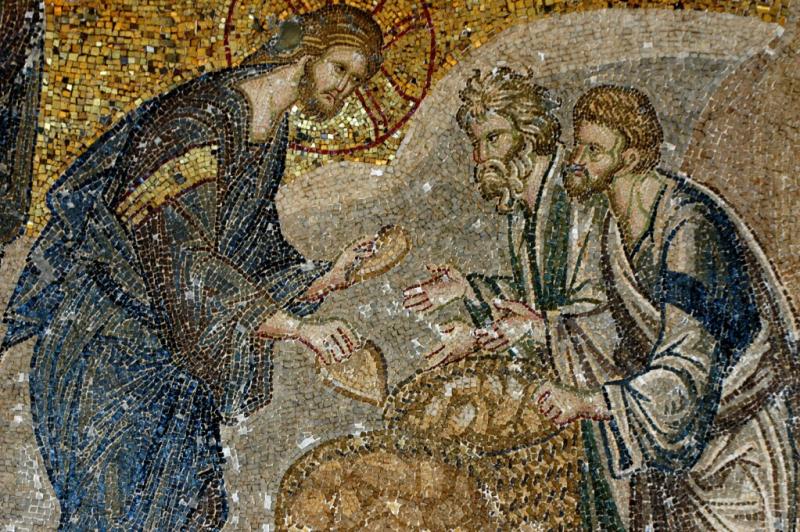
Fifthly, we encourage each other's gifts, be it five loaves or fifty loaves, one fish or a hundred fish.

Lastly, we love our readership, and attempt to meet needs in the Church, which includes clear writing which involves catechesis.

In medieval times, guilds formed a necessary part of society for physical and spiritual support.

Guilds had chaplains, as we do, and chapels, which we don't. However, we can pray for each other. I remember visiting the guild chapels in Malta above, and marvelling at the feeling of brotherhood and sisterhood one could absorb just standing in front of their altars, even after hundreds of years.

I am fortunate to live 200 feet away from a shrine to Blessed Titus Brandsma. I can pop into the church and pray for all my confrères, even though I do not light candles for all, which would cause a raging fire.

Let us remember each other in prayer as the days get darker for us all.  I believe that Blessed Titus would be very pleased to know we are supporting each other in prayer on a regular basis, for all of our needs.

God bless this Guild. And, if you want to read more about shoemakers, take a look at a little play found at this place.


Friday, 9 August 2013

Feast of St Teresa Benedicta of the Cross, Edith Stein

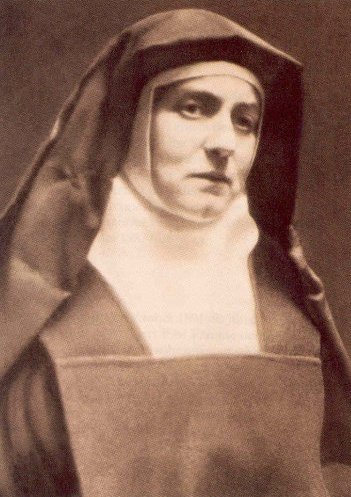
Today is the Feast of St Teresa Benedicta of the Cross, Edith Stein. I reproduce for readers this biography of the Saint, courtesy of the Vatican website. With Blessed Titus Brandsma, St Teresa Benedicta of the Cross stands as a martyr in defence of life, love, liberty the Catholic Church and the Jewish people. St Teresa Benedicta of the Cross, pray for us...

"We bow down before the testimony of the life and death of Edith Stein, an outstanding daughter of Israel and at the same time a daughter of the Carmelite Order, Sister Teresa Benedicta of the Cross, a personality who united within her rich life a dramatic synthesis of our century. It was the synthesis of a history full of deep wounds that are still hurting ... and also the synthesis of the full truth about man. All this came together in a single heart that remained restless and unfulfilled until it finally found rest in God." These were the words of Pope John Paul II when he beatified Edith Stein in Cologne on 1 May 1987.

Who was this woman?
 
Edith Stein was born in Breslau on 12 October 1891, the youngest of 11, as her family were celebrating Yom Kippur, that most important Jewish festival, the Feast of Atonement. "More than anything else, this helped make the youngest child very precious to her mother." Being born on this day was like a foreshadowing to Edith, a future Carmelite nun.

Edith's father, who ran a timber business, died when she had only just turned two. Her mother, a very devout, hard-working, strong-willed and truly wonderful woman, now had to fend for herself and to look after the family and their large business. However, she did not succeed in keeping up a living faith in her children. Edith lost her faith in God. "I consciously decided, of my own volition, to give up praying," she said.

In 1911 she passed her school-leaving exam with flying colours and enrolled at the University of Breslau to study German and history, though this was a mere "bread-and-butter" choice. Her real interest was in philosophy and in women's issues. She became a member of the Prussian Society for Women's Franchise. "When I was at school and during my first years at university," she wrote later, "I was a radical suffragette. Then I lost interest in the whole issue. Now I am looking for purely pragmatic solutions."

In 1913, Edith Stein transferred to G6ttingen University, to study under the mentorship of Edmund Husserl. She became his pupil and teaching assistant, and he later tutored her for a doctorate. At the time, anyone who was interested in philosophy was fascinated by Husserl's new view of reality, whereby the world as we perceive it does not merely exist in a Kantian way, in our subjective perception. His pupils saw his philosophy as a return to objects: "back to things". Husserl's phenomenology unwittingly led many of his pupils to the Christian faith. In G6ttingen Edith Stein also met the philosopher Max Scheler, who directed her attention to Roman Catholicism. Nevertheless, she did not neglect her "bread-and-butter" studies and passed her degree with distinction in January 1915, though she did not follow it up with teacher training.

"I no longer have a life of my own," she wrote at the beginning of the First World War, having done a nursing course and gone to serve in an Austrian field hospital. This was a hard time for her, during which she looked after the sick in the typhus ward, worked in an operating theatre, and saw young people die. When the hospital was dissolved, in 1916, she followed Husserl as his assistant to the German city of Freiburg, where she passed her doctorate summa cum laude (with the utmost distinction) in 1917, after writing a thesis on "The Problem of Empathy."

During this period she went to Frankfurt Cathedral and saw a woman with a shopping basket going in to kneel for a brief prayer. "This was something totally new to me. In the synagogues and Protestant churches I had visited people simply went to the services. Here, however, I saw someone coming straight from the busy marketplace into this empty church, as if she was going to have an intimate conversation. It was something I never forgot. "Towards the end of her dissertation she wrote: "There have been people who believed that a sudden change had occurred within them and that this was a result of God's grace." How could she come to such a conclusion?

Edith Stein had been good friends with Husserl's Göttingen assistant, Adolf Reinach, and his wife.
When Reinach fell in Flanders in November 1917, Edith went to Göttingen to visit his widow. The Reinachs had converted to Protestantism. Edith felt uneasy about meeting the young widow at first, but was surprised when she actually met with a woman of faith. "This was my first encounter with the Cross and the divine power it imparts to those who bear it ... it was the moment when my unbelief collapsed and Christ began to shine his light on me - Christ in the mystery of the Cross."

Later, she wrote: "Things were in God's plan which I had not planned at all. I am coming to the living faith and conviction that - from God's point of view - there is no chance and that the whole of my life, down to every detail, has been mapped out in God's divine providence and makes complete and perfect sense in God's all-seeing eyes."

In Autumn 1918 Edith Stein gave up her job as Husserl's teaching assistant. She wanted to work independently. It was not until 1930 that she saw Husserl again after her conversion, and she shared with him about her faith, as she would have liked him to become a Christian, too. Then she wrote down the amazing words: "Every time I feel my powerlessness and inability to influence people directly, I become more keenly aware of the necessity of my own holocaust."

Edith Stein wanted to obtain a professorship, a goal that was impossible for a woman at the time. Husserl wrote the following reference: "Should academic careers be opened up to ladies, then I can recommend her whole-heartedly and as my first choice for admission to a professorship." Later, she was refused a professorship on account of her Jewishness.

Back in Breslau, Edith Stein began to write articles about the philosophical foundation of psychology. However, she also read the New Testament, Kierkegaard and Ignatius of Loyola's Spiritual Exercises. She felt that one could not just read a book like that, but had to put it into practice.

In the summer of 1921. she spent several weeks in Bergzabern (in the Palatinate) on the country estate of Hedwig Conrad-Martius, another pupil of Husserl's. Hedwig had converted to Protestantism with her husband. One evening Edith picked up an autobiography of St. Teresa of Avila and read this book all night. "When I had finished the book, I said to myself: This is the truth." Later, looking back on her life, she wrote: "My longing for truth was a single prayer."

On 1 January 1922 Edith Stein was baptized. It was the Feast of the Circumcision of Jesus, when Jesus entered into the covenant of Abraham. Edith Stein stood by the baptismal font, wearing Hedwig Conrad-Martius' white wedding cloak. Hedwig washer godmother. "I had given up practising my Jewish religion when I was a 14-year-old girl and did not begin to feel Jewish again until I had returned to God." From this moment on she was continually aware that she belonged to Christ not only spiritually, but also through her blood. At the Feast of the Purification of Mary - another day with an Old Testament reference - she was confirmed by the Bishop of Speyer in his private chapel.

After her conversion she went straight to Breslau: "Mother," she said, "I am a Catholic." The two women cried. Hedwig Conrad Martius wrote: "Behold, two Israelites indeed, in whom is no deceit!" (cf. John 1:47).

Immediately after her conversion she wanted to join a Carmelite convent. However, her spiritual mentors, Vicar-General Schwind of Speyer, and Erich Przywara SJ, stopped her from doing so. Until Easter 1931 she held a position teaching German and history at the Dominican Sisters' school and teacher training college of St. Magdalen's Convent in Speyer. At the same time she was encouraged by Arch-Abbot Raphael Walzer of Beuron Abbey to accept extensive speaking engagements, mainly on women's issues. "During the time immediately before and quite some time after my conversion I ... thought that leading a religious life meant giving up all earthly things and having one's mind fixed on divine things only. Gradually, however, I learnt that other things are expected of us in this world... I even believe that the deeper someone is drawn to God, the more he has to `get beyond himself' in this sense, that is, go into the world and carry divine life into it."

She worked enormously hard, translating the letters and diaries of Cardinal Newman from his pre-Catholic period as well as Thomas Aquinas' Quaestiones Disputatae de Veritate. The latter was a very free translation, for the sake of dialogue with modern philosophy. Erich Przywara also encouraged her to write her own philosophical works. She learnt that it was possible to "pursue scholarship as a service to God... It was not until I had understood this that I seriously began to approach academic work again." To gain strength for her life and work, she frequently went to the Benedictine Monastery of Beuron, to celebrate the great festivals of the Church year.

In 1931 Edith Stein left the convent school in Speyer and devoted herself to working for a professorship again, this time in Breslau and Freiburg, though her endeavours were in vain. It was then that she wrote Potency and Act, a study of the central concepts developed by Thomas Aquinas. Later, at the Carmelite Convent in Cologne, she rewrote this study to produce her main philosophical and theological oeuvre, Finite and Eternal Being. By then, however, it was no longer possible to print the book.

In 1932 she accepted a lectureship position at the Roman Catholic division of the German Institute for Educational Studies at the University of Munster, where she developed her anthropology. She successfully combined scholarship and faith in her work and her teaching, seeking to be a "tool of the Lord" in everything she taught. "If anyone comes to me, I want to lead them to Him."

In 1933 darkness broke out over Germany. "I had heard of severe measures against Jews before. But now it dawned on me that God had laid his hand heavily on His people, and that the destiny of these people would also be mine." The Aryan Law of the Nazis made it impossible for Edith Stein to continue teaching. "If I can't go on here, then there are no longer any opportunities for me in Germany," she wrote; "I had become a stranger in the world."

The Arch-Abbot of Beuron, Walzer, now no longer stopped her from entering a Carmelite convent. While in Speyer, she had already taken a vow of poverty, chastity and obedience. In 1933 she met with the prioress of the Carmelite Convent in Cologne. "Human activities cannot help us, but only the suffering of Christ. It is my desire to share in it."

Edith Stein went to Breslau for the last time, to say good-bye to her mother and her family. Her last day at home was her birthday, 12 October, which was also the last day of the Feast of Tabernacles. Edith went to the synagogue with her mother. It was a hard day for the two women. "Why did you get to know it [Christianity]?" her mother asked, "I don't want to say anything against him. He may have been a very good person. But why did he make himself God?" Edith's mother cried. The following day Edith was on the train to Cologne. "I did not feel any passionate joy. What I had just experienced was too terrible. But I felt a profound peace - in the safe haven of God's will." From now on she wrote to her mother every week, though she never received any replies. Instead, her sister Rosa sent her news from Breslau.

Edith joined the Carmelite Convent of Cologne on 14 October, and her investiture took place on 15 April, 1934. The mass was celebrated by the Arch-Abbot of Beuron. Edith Stein was now known as Sister Teresia Benedicta a Cruce - Teresa, Blessed of the Cross. In 1938 she wrote: "I understood the cross as the destiny of God's people, which was beginning to be apparent at the time (1933). I felt that those who understood the Cross of Christ should take it upon themselves on everybody's behalf. Of course, I know better now what it means to be wedded to the Lord in the sign of the cross. However, one can never comprehend it, because it is a mystery." On 21 April 1935 she took her temporary vows. On 14 September 1936, the renewal of her vows coincided with her mother's death in Breslau. "My mother held on to her faith to the last moment. But as her faith and her firm trust in her God ... were the last thing that was still alive in the throes of her death, I am confident that she will have met a very merciful judge and that she is now my most faithful helper, so that I can reach the goal as well."

When she made her eternal profession on 21 April 1938, she had the words of St. John of the Cross printed on her devotional picture: "Henceforth my only vocation is to love." Her final work was to be devoted to this author.

Edith Stein's entry into the Carmelite Order was not escapism. "Those who join the Carmelite Order are not lost to their near and dear ones, but have been won for them, because it is our vocation to intercede to God for everyone." In particular, she interceded to God for her people: "I keep thinking of Queen Esther who was taken away from her people precisely because God wanted her to plead with the king on behalf of her nation. I am a very poor and powerless little Esther, but the King who has chosen me is infinitely great and merciful. This is great comfort." (31 October 1938)

On 9 November 1938 the anti-Semitism of the Nazis became apparent to the whole world.

Synagogues were burnt, and the Jewish people were subjected to terror. The prioress of the Carmelite Convent in Cologne did her utmost to take Sister Teresia Benedicta a Cruce abroad. On New Year's Eve 1938 she was smuggled across the border into the Netherlands, to the Carmelite Convent in Echt in the Province of Limburg. This is where she wrote her will on 9 June 1939: "Even now I accept the death that God has prepared for me in complete submission and with joy as being his most holy will for me. I ask the Lord to accept my life and my death ... so that the Lord will be accepted by His people and that His Kingdom may come in glory, for the salvation of Germany and the peace of the world."

While in the Cologne convent, Edith Stein had been given permission to start her academic studies again. Among other things, she wrote about "The Life of a Jewish Family" (that is, her own family): "I simply want to report what I experienced as part of Jewish humanity," she said, pointing out that "we who grew up in Judaism have a duty to bear witness ... to the young generation who are brought up in racial hatred from early childhood."

In Echt, Edith Stein hurriedly completed her study of "The Church's Teacher of Mysticism and the Father of the Carmelites, John of the Cross, on the Occasion of the 400th Anniversary of His Birth, 1542-1942." In 1941 she wrote to a friend, who was also a member of her order: "One can only gain a scientia crucis (knowledge of the cross) if one has thoroughly experienced the cross. I have been convinced of this from the first moment onwards and have said with all my heart: 'Ave, Crux, Spes unica' (I welcome you, Cross, our only hope)." Her study on St. John of the Cross is entitled: "Kreuzeswissenschaft" (The Science of the Cross).

Edith Stein was arrested by the Gestapo on 2 August 1942, while she was in the chapel with the other sisters. She was to report within five minutes, together with her sister Rosa, who had also converted and was serving at the Echt Convent. Her last words to be heard in Echt were addressed to Rosa: "Come, we are going for our people."

Together with many other Jewish Christians, the two women were taken to a transit camp in Amersfoort and then to Westerbork. This was an act of retaliation against the letter of protest written by the Dutch Roman Catholic Bishops against the pogroms and deportations of Jews. Edith commented, "I never knew that people could be like this, neither did I know that my brothers and sisters would have to suffer like this. ... I pray for them every hour. Will God hear my prayers? He will certainly hear them in their distress." Prof. Jan Nota, who was greatly attached to her, wrote later: "She is a witness to God's presence in a world where God is absent."

On 7 August, early in the morning, 987 Jews were deported to Auschwitz. It was probably on 9 August that Sister Teresia Benedicta a Cruce, her sister and many other of her people were gassed.

When Edith Stein was beatified in Cologne on 1 May 1987, the Church honoured "a daughter of Israel", as Pope John Paul II put it, who, as a Catholic during Nazi persecution, remained faithful to the crucified Lord Jesus Christ and, as a Jew, to her people in loving faithfulness."

Wednesday, 7 August 2013

We are Living in a Time of Great Persecution and Schism

It is time to wake up the neighbors and the family members who have been quietly going about their business and saying that it could never happen.  It is already happening.  It is happening now.  The 'it' is the schism in the Roman Catholic church between, not liberals and rad-trads, but between the faithful Catholics and those who are contributing to the schism and persecution.

The following links will demonstrate the global nature of the persecution and resulting schism.  They are in no particular order.

These articles represent the tip of the iceberg.  These are the ones that come to my mind this morning.  I haven't really touched on the abuses within the church that are causing the schism.  If you have time, add some links in the comments box.  Awareness, education, and fidelity to the teachings of the Catholic church will be our weapons as we experience the white martyrdom of this persecution in Europe and the United States.  Let's remember to pray for those who are experiencing the red martyrdom in Muslim and Communist countries.

Tuesday, 6 August 2013

Hidden with Christ

Whilst on a recent holiday in Italy my family and I were taken by our host to visit a lively family of four girls. The eldest, a girl with an intelligent and gentle face, looked about ten years old.

She had a series of epileptic crises about two or three years ago, and after months of hospital, and trekking to and fro to neurology clinics the length of Italy, her parents brought her home to look after her. She sits in a wheelchair, and has been unable to talk or eat or move by herself since the crises, and is fed through a tube into the stomach, a P.E.G. tube. It is difficult to know how much she takes in of what is passing around her.

My wife's cousin, a young priest, visits the family when he can, and we had the privilege of joining him to celebrate the Eucharist at their home. It was brief, simple and reverent, with the sounds of the little ones playing in the garden drifting in. We had a short and pointed homily on the reading about Moses going out of the camp to the Tabernacle where the Divine Cloud of God's presence descended, and where Moses spoke to God as his friend - and how we must leave our daily round to enter into the place of holy and quiet in the presence of God, where we are brought in a hidden way into Heaven's inner court, the Sacred Heart of Christ.

The girl who sat in the wheelchair, Caterina by name, is loved by her younger sisters who do not behave as if there is anything odd or embarrassing about her being there in that way. They talk to, shout at, caress her in the most natural and unfussy way. It was impossible not to come away happier, humbler and with a sense of grace received in that place; perhaps even from that girl. What stuck with me was the sense - and I think the behaviour of her rowdy sisters had something to do with it - that there could be not be the shadow of a doubt in one's soul that Caterina was a person, no less than you or I.

St Paul: 'Your life is hid with Christ in God'
It set me thinking. An idea for an argument has been stirring in my head for a few years, which I have never quite been able to articulate. The simple and theological truth behind it, as I was reminded by a friend recently, is that "your life is hid with Christ in God". What follows might be a valid rationalising of that simple truth, and if it isn't, then you can always disregard what I will say and keep the words of St. Paul who spoke through the Holy Spirit.

There are two common notions of what a person is - one I will call performative, the other socially objective.

The performative notion says being a person is acting like one. The actions we normally expect from a person, the inner life of thinking and feeling, the outer life of communicating and willing, are what makes us who we are. If something does not perform these activities, it cannot be a person. In its crudest form this kind of philosophy would seem to say that we cease to be persons when we fall asleep, so it is usually modified by some kind of appeal to the notion of our potential capabilities. If I fall asleep I am still a person because I am still capable of waking up and doing things: if I were in a coma, i.e. utterly unable to wake or be awakened ever again, well, that would be a different story.

One can see, if this is the only kind of philosophy around, where the twilight will fall: on the very old, especially those who have lost their mind; on those badly injured or incapable of communicating; and on those so young that they appear not to have any capabilities at all. There is, I think, something somewhat Cartesian and dualistic about this way of thinking: the body (apart from the inner life of thinking and willing) can be discarded from considerations about the person. Rather like a computer which won't load up anymore - once one has extracted the information from the hard disk, the husk of metal and plastic had better be dumped - a person is really just the bit that processes and communicates information, and the machinery of the body (if it doesn't do its job) is so much rubbish. Respect due to someone e.g. with profound dementia, in this philosophy, is a kind indulgence to their relatives' sentimentality.

The socially objective notion, often a noble and valid reaction against the apparently cruel logic of the performative notion, is that every human being is a person, because of the kind of thing that human beings are together. We are objectively and en masse beings who feel, think and communicate, and are at bottom social beings. Part of the fact of being a person is to bear the responsibility of looking after others. If someone - at a certain stage of their life, or due to a lack of the usual human capabilities - is unable to think or act they are nevertheless part of human society, and we ought to look after them. The appeal in this notion is mostly, I suppose, to the Aristotelian notion of man as a social animal, and therefore an animal with social responsibilities. While one wouldn't object to the conclusion, I think that there is a step missing in this kind of argument. It isn't immediately obvious why every human being is a person, if by a person one means someone who thinks, feels etc. Surely the argument works by sleight of hand, concealing the fact that "person" and "member of the human species" do not have the same definition, but pretending that they do? We may or may not, says the critic, have a duty to all our fellow humans, but do we have a duty to respect every human as a person specifically?

The answer, I believe, lies in the definition of person, thrashed out in twelve centuries of theological dispute over the doctrine of the Trinity and the unity of human and divine in Christ, and present largely in its modern form when St. Thomas Aquinas laid down his quill for the last time. One of the greatest contributions, however, was made a generation before Aquinas, by Richard of St. Victor in his De Trinitate. There are three points from that seminal work that I would like to pick up on.

His first contribution was profoundly simple: when we think of things, we ask the question "what?" (e.g. what kind of thing is this?) When we speak of a person, we ask the question "who?" (e.g. who was that man?) The unique name of a person cannot be given to someone else: they are who they are, and who they are is - in his technical terminology - incommunicabilitas: their personhood cannot be someone else's, for they are themselves and no-one else. I think this makes a great deal of intuitive sense, for even if dementia or madness can be a frightening and alienating thing for the family of a sufferer, there is never a point at which the relatives say, "No, this is not a person any more". They may say "I have lost the person that he was", but that is something quite different: it is a loss of remembered characteristics (personality) of which they feel so bereaved, but the sense that this is a "who" is distinguishably a different matter.

The second point that Richard makes is that the persons of the Trinity are distinguished wholly by their relation to each other. Because the Father, Son and Spirit are eternal, they are not distinguished by any of the generic distinctions by which we tell each other apart - our height, the colour of our hair, etc. - but by the relation each has to the other. The Son is not the Father because the Son is begotten of the Father, and is filled by the Spirit which "is not given in measure [is not given partially, but utterly] unto him". While we are indeed partly who we are because of the colour of our hair etc., I think it is worth considering how little of our own person is a matter of our own making, and how completely our existence is found relation to others. Like the Son, we receive our existence from another. In fact, the conscious exercise of our will and thought depends utterly upon the datum or the gift of what we already are when the exercise of that will and thought is awakened in us. What we are in our freedom is what we do with the life given to us ultimately by our parents, the food they fed us, and what was fostered in us.

We are, from head to toe, from each atom and cell to total organism, from inmost desire to the blinking of our eyelid, relational beings embedded within our inheritance and the cosmos. Within this radical relation that is our existence, there is freedom and will, yes: but even that turns out to be exercised by virtue of the others around us. Because there are other talking beings who taught us to speak, we are free to talk to them - and only then to talk to ourselves (i.e. to think). We are only free to act as "social beings" because there are other social beings with which to act. In fact therefore, both our will and our inner life and its imaginative apparatus is parasitic on relation: our inflated notions of solitary selfhood are largely illusory projections. The only freedom to be ourselves is not actually to live in isolation, but to be a self in relation to others, and whether we like it or not that is our identity as person and the very seat of our individuality.

A pertinent moral lesson flows from the radically relative nature of our personhood, which is that the capabilities we think of as most central to us as persons are in fact not our primary reality. Having an "inner life" of thought and will is secondary to having been conceived and nourished and spoken to by others. Our reality as persons is in operation firstly by the gift of our existence, not by our self-awareness. The intuitive sense of a mother that their child, though so injured that they cannot move or speak, is a person, is rooted in this truth. The question about the personhood of embryos is also subtly shifted when this truth is accepted. It is no longer an argument about when an embryo attains sentience, or about the possession of the genetic material and potential of human development. For an embryo is not merely an abstract thing of science, it is something with two parents, and it is therefore a person through its relation to them. Their responsibility is continuous with their knowledge of the formation of that embryo.


The third and final point that I want to draw from Richard of St. Victor is that he sees the Holy Spirit as fully personal Love. "Relation" is a somewhat abstract and colourless term and does not describe something that exists at all: rather like Newtonian empty "space" (although Newton saw space as "location" to be fair to him, and as fact because of God's omnipresence). We would do better to speak instead with Dante of l'amor che move il sole e l'altre stelle, the love that moves the sun and the other stars.

There are fathers and sons, mothers and children, lovers and spouses, friends and enemies, all in some way or other entering into Love, or seeking to frustrate it. Our acts are not mere flailing around in a vacuum-like space called relation, but are either like light, beams pregnant with the energy of creation, or they are like darkness, horrible black holes of destructive self-imprisonment.

The philosophy of the person is in its form and import Trinitarian, partly because the formation of Trinitarian dogma and clarity about the philosophy of person came in tandem in the thirteenth century. One is a person because of one's relation to God: or, translated by Richard, one is a person because one is loved into existence by God. Whether waking or sleeping, whether one has lost one's mind or is sane, whether one cell or billions, the Holy Trinity is the centre and guarantee of one's personhood. Caterina is a person, I suppose, as are her sisters, because they exist in the life of the Holy Trinity. They are begotten by the Father in Christ, by the Spirit of Love. The difference between her and her sisters is that Caterina's will is more deeply hidden in Christ - like Moses in the tabernacle, she talks to God as a friend, and her dwelling is in the Shechinah, the Divine Glory of God's inner chamber. But one glimpses the Love in which she dwells by the way that girl is loved in that house.

Saturday, 3 August 2013

No school girls "gone wild" because of high humidity.


Some ridiculous studies in the U.S. have been tracing the higher rate in crime to heat waves. Now, my ancestors on the prairies of Iowa did not have air conditioning, nor did my ancestors on the ranches in Oregon.

People slept in the heat, ate in the heat, worked in the heat. They got rich in the heat, had lots of babies in the heat, and died as good Catholics in the heat. Women wore heavy. long sleeved blouses, and copious layers of skirts. Men wore long shirts to shield their arms from the sun. They lived a long time. My great-grandmother on the Oregon Trail died a week before she reached 100 years of age. She never had "air" in her life. My grandmother died at 94. She had "air" for a few years.

And, if one grows up on the Mississippi River, one knows what humidity is.


So, modern people need air conditioning to sleep, and get irritable in the heat. What happened to the life of virtue? What happened to coping with being uncomfortable? We have become soft, but not for long.

When I was in grade school, there was no air conditioning. We managed. By May 1st, temperatures in Iowa could easily be in the high 80s Fahrenheit. We managed. Same was true for high school, and we wore uniforms. We never thought of complaining. The weather was just that. The climate was just that. Nor did we commit horrible crimes after school in our green, heavy pleated skirts and blazers. No school girls gone wild because of high humidity.

So, why are social-psychologists making a connection to heat and crime, blaming sleep deprivation, stimulated hypothalami, and general grumpiness on the heat?

One simple reason: those in the world of science or, pseudo-science, if you prefer, cannot deal with the simple fact that two generations have been raised without a moral framework or without moral consequences.

The "time-out" bench did not work. And, the omitting of Faith-based education has created many malformed consciences, consciences which have no means of determining right or wrong, except for how persons "feel" at any particular moment,

To blame crime on the heat borders on magical thinking-like the pagans, who read signs and saw omens in the "entrails of an owl". To blame nature in general, (or climate or darkness), for bad behaviour has become a popular trend in psychoanalysis. Now, I have two members in my family who suffer from what is called seasonal affective disorder or SAD. For years, one travelled to Arizona on a regular basis to get away from the long, dark winters of Iowa. She never committed a crime, however. She knew her moral boundaries. The other coped, staying in cold, dark Iowa during the winters, and remained a virtuous woman as well. SAD was, for both of them, a personal cross.

I think the so-called modern world is falling back into pagan ways of thinking and a moral softness. The ancients prayed to their gods for prosperity, rain, abundant harvests, victory over their enemies, and then blamed the gods if their prayers were not answered. Only, now, modern gods are socialist governments.


The Hebrews were the only people who blamed themselves for disaster, and if one reads the Pentateuch, one sees the ebb and flow of sin and punishment. But, the People of God did not blame the heat-never. Read Joshua, Maccabees, and so on. God punished His People. We are possibly entering into a great time of purification of the Church, that is, the People of God. But, Catholics must think like Catholics.

We are sliding back into magical thinking in many ways. Any type of thinking which exonerates each one's personal responsibility to create a peaceful and ordered society will lead to more and more societal dysfunction.


Social dysfunction is the name of the game in Great Britain and in the States. When we remove the traditional, glorious Rule of Law based on the Greco-Romano-Judaic-Christian traditions of Western Civilization, and when we depart completely from natural law philosophy, whatever a government, or a people, or a cult suggests is law will be law. The law will be what Parliament or Congress or the President or Supreme Court decides it will be. The law will be what the EU Court of Justice will decide it will be. No framework of morals outside the relativism of the lawmakers and judges will determine laws.


Neo-paganism,  polytheismshamanismpantheism, and  animism are on the rise in what used to be Christian nations. The growth of these "isms" is directly related to relativism and individualism. Some of these "isms" fall under the larger grouping of New Age religious beliefs, many of which involve magical thinking, and, sadly, many which are followed by so-called Catholics.

As Catholics, we need to be aware of these types of faulty thinking and any magical thinking. 

We need to think like Catholics. Get strong..

DISCLAIMER--I had not read Chesterton's Essay found here  http://www.cse.dmu.ac.uk/~mward/gkc/books/misc.html#2H_4_0010 which was just bought to my attention.


Thursday, 1 August 2013

Persecution Watch-Great Britain

http://www.christian.org.uk/news/gay-couple-to-sue-church-over-gay-marriage-opt-out/

Many of us bloggers warned about the repercussions of this same-sex-"marriage" bill earlier this year. See my other post earlier this year on this blog.

But, the blame is to partially be put on the shoulders of those who did not speak up at the time. My pastor in Sussex did, daily, for almost two weeks. An excellent priest, he said the passage of the bill, (and he was speaking while it was before the House of Commons), would effect everyone's lives, men, women, children, grandparents.

And, those who will be hit with fines and even imprisonment will be the clergy first.

Time for all of us to examine out consciences and pray for holiness and perseverance. We have seen all of this before.

St John Fisher said these things:

"The fort is betrayed,even by those who should have defended it."  


"Not that I condemn any other men's conscience. Their conscience may save them, and mine must save me."


Feast Day of the Maccabees


from the Orthodox Divine Liturgy, Troparion, Tone I

By the pangs of the saints,/ which they suffered for Thee, O Lord,/ be Thou entreated, and heal Thou all our infirmities,// we pray Thee, O Thou
 Who lovest mankind.

In this icon, some of the martyrs are holding crosses, as this day also celebrates the Holy Cross in the Orthodox Church. In the Tridentine Liturgy, the EF, this feast of the martyrs is still celebrated today as well.


I love the Books of the Maccabees and read these every so many months. If you have not read or studied these inspired texts, do so, as the messages within are timely. Here is one of the readings from the Orthodox Divine Liturgy today.


Hebrews 11:33-12:2 (Epistle, Martyrs)
33
who through faith subdued kingdoms, worked righteousness, obtained promises, stopped the mouths of lions,
34
quenched the violence of fire, escaped the edge of the sword, out of weakness were made strong, became valiant in battle, turned to flight the armies of the aliens.
35
Women received their dead raised to life again. Others were tortured, not accepting deliverance, that they might obtain a better resurrection.
36
Still others had trial of mockings and scourgings, yes, and of chains and imprisonment.
37
They were stoned, they were sawn in two, were tempted, were slain with the sword. They wandered about in sheepskins and goatskins, being destitute, afflicted, tormented-
38
of whom the world was not worthy. They wandered in deserts and mountains, in dens and caves of the earth.
39
And all these, having obtained a good testimony through faith, did not receive the promise,
40
God having provided something better for us, that they should not be made perfect apart from us.
1
Therefore we also, since we are surrounded by so great a cloud of witnesses, let us lay aside every weight, and the sin which so easily ensnares us, and let us run with endurance the race that is set before us,
2
looking unto Jesus, the author and finisher of our faith, who for the joy that was set before Him endured the cross, despising the shame, and has sat down at the right hand of the throne of God.

Related Posts Plugin for WordPress, Blogger...