"Blessed" Alan de la Roche, O.P. (1428-1475) was a 15th Century friar who is considered to be the restorer of the Dominican Rosary. Although Alan has no official Church feast day, he is unofficially honored on September 8th, which is also the feast for the Nativity of Mary.
According to Dominican tradition, St. Dominic (1170-1221) founded the Rosary in 1208 as a meditative prayer which sought to spiritually combat the Albigensian heresy (which believed that only spiritual realities were good and vehemently opposed God taking flesh in Jesus Christ). But this meditative Marian prayer featuring just the Angelic Salutation and the Evangelical Salutation fell into disuse during the 14th Century during the era of the Black Death in Europe.
In the mid 15th Century in a Dominican monastery in Brittany, Alan de la Roche experienced visions from the Blessed Virgin Mary and the Lord which eventually convicted him to revive and renew the Dominican Rosary. De la Roche was not the perfect emissary for this divine mission. At one point, Jesus appeared to De la Roche and said: "You have all of the learning and understand that you need to preach my mother's rosary, and you are not doing so. The world is full of devouring wolves, and you, unfaithful dog, know not how to bark." The latter phrase was a pointed wake up call to a Dominican like Blessed Alan, as the Order of Preachers held the moniker "Dog of God" (Latin domini canus which sounds similar to Dominicanus)
Blessed Alan stressed the 15 mysteries of the Dominican Rosary, rather than the alternative of 50 clauses of the Carthusian Rosary. Moreover, the 150 Hail Marys imitated the 150 psalms of the Old Testament, which harkened back to the proto-origins of the lay Marian psalter. Blessed Alan was successful at renewing popular devotion to the Rosary and reinvigorating the Confraternity of the Rosary. The Confraternity featured "after death" benefits for Rosarians. Thus Blessed Alan de la Roche may be considered one the greatest champions of the Rosary to ever live.
Although Blessed Alan wrote an instructional pamphlet Book and Ordinance regarding the renewal of the Dominican Rosary, about 1/3 of the Vatican documents were lost after Napoleon sacked the Vatican archives from 1810-1813. So much of quotable material about Blessed Alan comes from St. Louis de Montfort (1673-1716) whose 18th Century works True Devotions to the Blessed Virgin and The Secret of the Rosary were buried in a field in France for over 125 years, thereby escaping the irreligious impulses of the French Revolution.
Juan Diego was a simple aboriginal American who had converted to Catholicism. On December 9th, 1591, Juan Diego saw an apparition of the Virgin Mary, who asked that a church be built on that hill. Juan Diego conveyed the message to the bishop, who wanted proof for his incredible apparition story. Juan Diego returned to the sight and bought back a tilma of out of season roses as proof.
When the peasant revealed what was in his tilma, the bishop and the entourage dropped to their knees as the simple garment had a portrait of a mestizo Blessed Virgin Mary, replete with symbolic Aztec hermanuetics.
Within a decade, nearly the entire Mexico people converted to the faith. And the humble tilma, which should have only lasted for 25 years has lasted for over 400 years.
Jack T. Chick died at the age of 92 in Glendale, California. Chick was infamous for publishing fundamentalist Christian tracts in the form of comic books for six decades and distributed over 750 million copies and has been translated into over 100 languages.
***
Chick's personal paranoia carried over into his funny paper tracts. While he railed against rock and roll, homosexuality and witchcraft, Chick saved most of his spite for Catholicism. If one were to believe Chick. Catholicism was created by Satan, that Popes take their marching orders from the devil. Chick blamed the Jesuits for starting the American Civil War (and that the "men in black" backed the Confederacy) as well as the Ku Klux Klan (which hated Catholics).
In addition, Chick claimed that the Catholic Church supposedly started Nazism, Communism, Islam, Masonry, Jehovah's Witnesses, Mormons and the New Age movement. Chick pinned the assassination of Abraham Lincoln and John F. Kennedy on the Vatican as well as the Holocaust. Continuing in this craziness, Chick surmised that the Vatican runs the United Nations and global finances and the Illuminati.. Amongst the biggest whoppers was that the Vatican has a super computer that tracks the names of every Protestant in the world.
Naturally, in the end times Chick proclaimed that the Antichrist would be the last Pope. It must have really freaked Chick out that Pope Francis is from the Society of Jesus (i.e. a Jesuit). No surprise that Catholic anti-defamation groups chronicled Chick tracts for over three decades.
***
One of Jack Chick's early successes was an early 1960s tract of a playboy who dies and is forced to watch all of his life's foibles on a big screen before the pearly gates of Heaven. Perhaps during this Extraordinary Jubilee Year of Mercy, Chick's imagined screening of "This Was Your Life" at the Pearl Gates Cinescreen won't be taken as "The Nightmare World of Jack Chick" but will be viewed as a Comedy of Manners.
The Feast of the Exaltation of the Holy Cross (also known as Roodmas) is a solemnity which celebrates three distinct historical events: the finding of the True Cross by St. Helena, the retrieval of the sacred relic by Emperor Heraclius in 629 from the Persians and the ineffable powers of the instrument of Christ's redemptive sacrifice and our salvation. The Holy Cross is exalted like Moses lifted up the Bronze Serpent in Exodus and those who looked upon it lived. Jesus willingly sacrificed Himself so that we all may enjoy eternal life.
In the early 20th Century, Sister Maria Teresa Desandais was blessed with mystical experiences about Jesus' Merciful Love. She wrote about these experiences under the pseudonym "Sulamitis PM". In 1912, Sr. Desandais, who had no training in painting, was inspired to create the picture "Merciful Love" which depicted Christ crucified looking towards heaven with a host in the background with the initials JHS. Rays of light emanating from the Sacred Heart of Jesus illuminate a Bible laying at the foot of the cross turned to the passage "Love one another as I have loved you" alongside a crown. That is an incredible amount of symbolic meaning suffused in one scene, particularly for an amateur painter.
This message of Merciful Love was widespread in France and Spain after the First World War. To bolster devotion to Merciful Love, Sr. Desandais sent two of her paintings to Spain. The painting sent to Juana Lacasa effectively became a place of pilgrimage. The other painting was installed at the Royal Basilica of Our Lady of Atocha in Madrid where Sister Maria Teresa's order was attached.
It is quite conceivable that the message of Merciful Love of Jesus with the exhortation to be servants who love one another may well have influenced Pope Francis for the Year of Divine Mercy.
Part of Sister Maria Teresa's revelations was an offering to Merciful Love:
Holy Father, through the Immaculate Heart of Mary, I offer to you Jesus, your beloved Son, and I offer myself in Him and through Him, and with Him for all your intentions, and on behalf of all creatures.
St. John Eudes was a Seventeenth Century Normand French cleric who extolled the virtues of a devotion to Sacred Heart started observing a feast for the heart of Mary in 1643. When Pope Leo XIII proclaimed Eudes heroic virtues in 1903, he was proclaimed "Author of the Liturgical Worship of the Sacred Heart of Jesus and Holy Heart of Mary".
Pope Pius VI in 1799 granted a limited feast to "The Most Pure Heart of Mary" in Polermo. In 1805, Pope Pius VII made a new concession which spread the practice more broadly. In 1855, the office and Mass of the Most Pure Heart of Mary was approved. In 1944, Pope Pius XII instituted the Feast of the Immaculate Heart of Mary in 1944 to be celebrated on August 22. In 1969, Pope Paul VI moved the feast to the third Saturday after Pentacost, immediately after the the Solemnity of Sacred Heart of Jesus.
The heart that resembles that of Christ more than any other is without a doubt the Heart of Mary, his Immaculate Mother, and for this very reason the liturgy holds them up together for our veneration. Responding to the Virgin's invitation at Fatima, let us entrust the whole world to her Immaculate Heart, which we contemplated yesterday in a special way, so that it may experience the merciful love of God and know true peace.
Because of the
strong analogy between Jesus and Mary, the consecration to Mary's Immaculate
Heart is closely linked to the consecration to Jesus' Sacred Heart, although it
is subordinate and dependent on it. That is, although the act of consecration
is ultimately addressed to God, it is an act that is made through Mary.
The aim of the
devotion to the Immaculate Heart of Mary is to unite mankind to God through Mary's heart, via consecration and reparation. One who is consecrated to Mary's Immaculate Heart as a way of being totally devoted to God. This involves a total gift of self, something possible only with reference to God but Mary is the intermediary in this process of consecration.
O
Most Blessed Mother, heart of love, heart of mercy, ever listening, caring,
consoling, hear our prayer. As your children, we implore your intercession with
Jesus your Son. Receive with understanding and compassion the petitions we
place before you today, especially ...(special
intention).
We
are comforted in knowing your heart is ever open to those who ask for your
prayer. We trust to your gentle care and intercession, those whom we love and
who are sick or lonely or hurting. Help all of us, Holy Mother, to bear our
burdens in this life until we may share eternal life and peace with God
forever. Amen.
The first Office and Mass of the Sacred Heart were composed by St. John Eudes, but the institution of the feast was a result of the appearances of our Lord to St. Margaret Mary Alacoque in 1675. The celebration of the feast was extended to the general calendar of the Church by Pius IX in 1856.
O most holy heart of Jesus, fountain of every blessing, I adore you, I love you, and with lively sorrow for my sins I offer you this poor heart of mine. Make me humble, patient, pure and wholly obedient to your will. Grant, Good Jesus, that I may live in you and for you. Protect me in the midst of danger. Comfort me in my afflictions. Give me health of body, assistance in my temporal needs, your blessing on all that I do, and the grace of a holy death. Amen.
The Feast of the Annunciation, or Lady Day, is normally celebrated on March 25 which is nine months before Christmas. However, this year March 25th was Good Friday, so it is inconceivable to observe such a solemnity on the same day so the liturgical observance of Lady Day was moved.
Eastern Catholic Churches, like the Melkites, observed the Annunciation on March 28th, the day after Easter. In the Roman Catholic Church, the Octave of Easter is eight days, so the Solemnity of the Annunciation was moved to April 4th.
Lady Day used to be the start of the New Year in England from 1155-1752. With calendar changes, the observance moved from April 5th (old Lady Day) to April 6th. One vestige of considering Lady Day as the start of the year is that the United Kingdom's tax year starts on Lady Day.
Sometimes the miracle of the Annunciation gets glossed over in Christmastide or it gets confused with the Immaculate Conception of Mary. As one contemplates the Joyful Mysteries of the Rosary, one gets a glimpse at how the Lord can be surprising and nothing is impossible for God to choose a humble virgin full of grace from the backwater country to be the Mother of God.
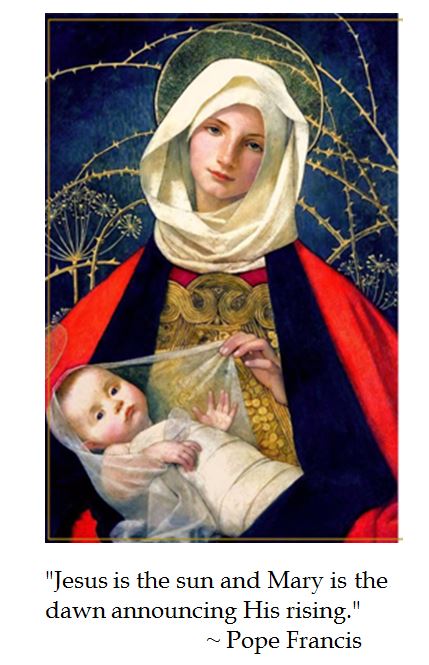
As Scripture and Holy Tradition has it, Mary is the first believer and all of her actions point to her Son Jesus. Hence Pope Francis' pearl of wisdom about Mary being like the figurative sunrise for her son (metaphorical sun) Jesus.
Today is the feast of Our Lady of Guadalupe, the Patroness of the Americas and of Mexico.
In the 1640s, a peasant named Juan Diego was walking between his village and Mexico City and he saw a vision of a girl approximately sixteen years old surrounded by light on Tepeyac Hill. Speaking to him in Nahuatl, the local language, she asked Juan Diego that a church be built on Tepeyac Hill in her honor. Juan Diego recognized the vision and the Virgin Mary. The Bishop instructed Juan Diego to return to Tepeyac and ask the lady for a miraculous sign to prove her identity. The visage instructed Juan Diego to gather flowers from the top of Tepeyac Hill. The usually barren Tepeyac Hill was blooming in Castilian roses, which were not native to Mexico. Juan Diego gathered the roses which the Virgin arranged in his tilma cloak. When the peasant opened the cloak before the Bishop, the flowers fell to the floor and an image of the Virgin of Guadalupe was miraculously imprinted on the fabric.
Pope John Paul II canonized St. Juan Diego Cuauhtlatoatzin in 2002. And in 1999, Pope John Paul II elevated Our Lady of Guadalupe to a Solemnity in all of the Americas.
The iconography of the image of Our Lady of Guadalupe was understood as being the Woman of the Apocalypse from Revelations 12:2 "clothed with the sun, and the moon under her feet, and upon her head a crown of twelve stars”. Yet there are hermeneutical images that appealed to indigenous Americans too. The Lady’s blue-green mantle was a hue reserved for the divine couple Ometecuhtli and Omecihuatl. A cross shaped image below the sash is the nahui-ollin and indicates the cosmos. The rays of light look like maguey spines, the source of the sacred beverage pulque (and tequila). Moreover, Many understand the black girdle along the Lady’s belt to indicate pregnancy, so Our Lady of Guadalupe is also unofficially considered the Patroness of the Unborn to the Pro-Life movement.
The rose amidst winter’s cold is an image of Advent which is not isolated to Our Lady of Guadalupe. A Spotless Rose is a 15th Century German carol.
A spotless Rose is blowing,Sprung from a tender root,Of ancient seers' foreshowing,Of Jesse promised fruit;Its fairest bud unfolds to lightAnd in the dark midnight,Amid the winter cold,A spotless Rose unfolds.
The Rose which I am singing,Whereof Isaiah said,Is from its sweet root springing,In Mary, purest Maid;For, through our God's great love and might,And in the dark midnight,Amid the winter cold,The blesse`d Babe she bare.
Many of the Catholic Faithful appreciate the Feast of Christ the King as marking the end of the liturgical year. Those who pay attention to the scriptures explore eschatological issues.
But it is useful to understand why the Feast of Christ the King was added to the Church calendar in 1925, through Pope Pius XI's Apostolic Letter Quas primus (1925). The Feast of Our Lord Christ the King emerged at a time in which nationalism, secularism, fascism and communism was sweeping the world. It was placed as the last Sunday in October, and was intended to give the faithful strength and courage to live the Kingdom of God in this world.
In a motu propio Mysterii Paschalis (1969) by Pope Blessed Paul VI, the feast was moved up to be a Solemnity and given a new formal name "Our Lord Jesus Christ, King of the Universe". By moving it to the last Sunday on the liturgical calendar, the significance of last things becomes more poignant.
Many Protestant and Orthodox Christians, such as the Anglicans, Lutherans and the Russian Orthodox outside of Russia followed the motu propio after 1970 and moved celebration of "Christ the King" to the last Sunday before the start of Advent.
H/T: Fr. Geoffrey Plant, St. Michael's Catholic Church, Lane Cove, Archdiocese of Sydney, Australia
O Victorious Lady,
Thou who has ever such powerful influence
with Thy Divine Son,
in conquering the hardest of hearts,
intercede for those for whom we pray,
that their hearts being softened
by the ways of Divine Grace,
they may return to the unity of the true Faith,
through Christ, our Lord.
Amen
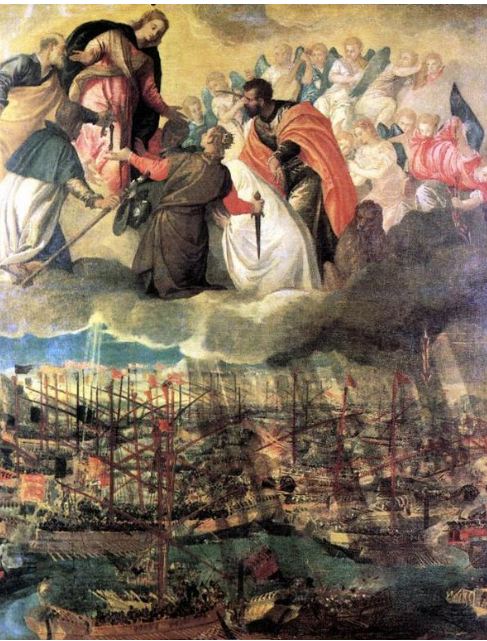
Today is also the anniversary of Our Lady of Victory. In 1571, the Turks had amassed a large fleet for an invasion of Italy. Pope St. Pius V blessed a pre-emptive strike by a small fleet led by Don Juan of Austuria (the bastard son of the King of Spain) near the Gulf of Lepanto to save Western civilization.
The two greatest naval forces ever assembled — 280 ships in the Turkish Armada, some 212 on the Christian side. Turkish Admiral Ali Pasha was so confident that he sailed proudly at the center of his own Armada, bringing with him on vessels just to his rear his entire fortune, and even a part of his harem.
There seemed little hopes for the Christian armada. The pope requested that the faithful say the rosary for the victory of the Christian fleet. The passion for defending their own civilization against ruthless invaders also strengthened the muscles of those engaged in the close, bloody, violent hand-fighting when one vessel came alongside another.
The Christian fleet were aided by cannon power.
Don Juan aimed his own galley directly at the heart of the Turkish armada, directly at the clearly colored sails of the Ali Pasha’s galley, with its great green flag, inscribed 28,000 times with the name of Allah in gold. Pasha was captured by Don Juan.
The Christian victory was far more complete than anyone had dreamed. The victory seemed to many quite miraculous, and victory was immediately attributed to Our Lady Queen of the Rosary — soon to be called by a new title, Our Lady Queen of Victory. In 1573, the feast name was changed to "Our Lady of the Rosary." Pope Pius X changed the feast day to October 7th to restore the celebration of the liturgy on Sundays.
For the last several years , the U.S. Council of Catholic Bishops orchestrated "The Fortnight for Freedom", two weeks of education, prayer and fasting to celebrate America's Constitutional First Freedom, the freedom of religious expression. In addition, many Christians are engaged in 40 days of prayer and fasting for America. The victory of the Battle of Lepanto ought to be another encouraging example on the power of prayer.
According to the Gregorian calendar, April 23rd is the Feast of St. George (or Georgemas). The Orthodox also admire the attributes of St. George but follow the Julian calendar which marks the feast on May 6th. St. George born in Syria Palestrinia in the late Third Century who served as an officer in the Roman army that guarded the Emporer Diocletian, but who was martyred for not renouncing his Christian faith. The emperor tried to bribe George to renounce his faith and tortured him, but to no avail. Before he was decapitated, St. George gave all of his wealth to the poor.
St. George is one of the most venerated saints in the Catholic Church, among Anglicans, Orthodox, East Syrian churches. Even Muslims revere this honorable military man. In the Twelfth Century a legend was attached to St. George about slaying a dragon. The standard Orthodox icon of St. George depicts him slaying a dragon with a woman in the background.
The dragon is generally understood as being both Satan and the monster from his own life (Diocletian). The woman in the background is Alexandra, the wife of Emperor Diocletian. Crusaders credit an appearance of St. George. This was probably legend which traveled back with the Crusaders from the Holy Land and was embellished in courtly Romance retellings.
***
St. George is the patron saint of England yet it is not a public holiday in England. The reasons why celebration of Georgemas is muted are cultural, historical and now tinged with political correctness.
St. George was neither English nor roundly associated with England, even though King Edward III formed the Order of the Garder under the patronage of St. George in 1348. The Reformation played a part as Protestants did not care much for saints' days. In addition, celebration of St. George's day has been in decline since the Act of Union between England in Scotland completed in 1707. In today's world, the Daily Telegraph reports that many English people are concerned that national symbols like St. George can be considered racists,
Aside from the fact that many pubs in England are named after George and the dragon, it makes one wonder why this legend matters. Modern man is quick to dismiss myths (unless it is anthropogenic global warming), but this is short sighted. Myths convey essential truths although the romantic story elements may not be exact.
***
The reason that St. George matters so much to the English is that the legend reinforces characteristics which the English admire and seek to emulate. St. George is a knight who exemplified chivalry. St. George and the dragon also champions the little guy as well as the triumph of good over evil. The versions which depict him making the sign of the cross depict deep dedication to principles (if we dare not declare faith). These romanticized virtues along with the more verifiable versions of his hagiography make St. George a man worthy (bank holiday or not) for Englishmen to emulate.
Remember, remember the Fifth of November,
The Gunpowder Treason and Plot,
I know of no reason
Why the Gunpowder Treason
Should ever be forgot.
Guy Fawkes, Guy Fawkes, 'twas his intent
To blow up the King and Parli'ment.
Three-score barrels of powder below
To prove old England's overthrow;
By God's providence [or By God's mercy] he was catch'd
With a dark lantern and burning match.
Hulloa boys, Hulloa boys, let the bells ring.
Hulloa boys, hulloa boys, God save the King!
A penny loaf to feed the Pope.
A farthing o' cheese to choke him.
A pint of beer to rinse it down.
A faggot of sticks to burn him.
Burn him in a tub of tar.
Burn him like a blazing star.
Burn his body from his head.
Then we'll say ol' Pope is dead.
Hip hip hoorah!
Hip hip hoorah!
Today is Guy Fawkes day in the UK. Today it seems treated as just another bank holiday to enjoy carousing and fireworks. Despite the 400 years that separates them, the Gunpowder Plot is analogous to the Islamists attacks on 9/11/2001.
The Protestant Reformation in England was not simply King Henry VIII making himself the supreme head of the English church in 1534. After Queen Elizabeth I assumed the English throne after the Catholic Queen Mary, there were a series of Sixteenth Century laws enacted to reinforce Protestant dominion over England. The Act of Uniformity from 1558 forced subjects to attend Anglican Churches and use the Book of Common Prayer. Fines for following one's conscience became exorbitant for most Catholics, it became treasonous to be absolved from schism, Jesuits were banned and priests were executed.
After the death of the "virgin" Queen and the demise of the Tudor dynasty, King James I was settling into power under the aegis of the Stuart dynasty in a de facto united kingdom of Scotland, England and Wales. Aggrieved Catholic partisans hoped to restore a Catholic monarchy to England. Guy Fawkes was a Catholic convert who fought in religious wars on the continent. When he returned to England, he plotted with others to attempt regicide. Fawkes and his cohorts leased an undercroft which was directly beneath the House of Lords. The plan was to blow up Westminster Palace (the Houses of Parliament) with 36 barrels of gunpowder. Black humorist quip that Fawkes was the only man to ever enter Parliament with honest intentions.
[The Discovery of the Gunpowder Plot/ Henry Peronnet Briggs c. 1823]
The plot failed in part because Parliament delayed meeting for several months due to threats of the Plague. Some of the gunpowder had decayed during the delay. Concerns about Catholics being in the chambers may have tipped off security. In the end, an anonymous tip turned Guy Fawkes in on November 5th as he was guarding his stash of explosives.
Fawkes was not cooperative after he had been taken into custody. In fact, he earned some admiration from James I for his "Roman Resolution". Fawkes was transferred to the Tower of London where his interrogators were authorized to start easy and proceed to the worst, hence starting with manacles to potentially the rack. After a few days of torture, Fawkes told all and was forced to sign a confession.
Almost three months later, Fawkes and seven cohorts had a pro-forma trial at the Star Chamber. Fawkes and three others were slated for public execution. The others were hanged, drawn and quartered. Fawkes begged for forgiveness from the King and the state while still keeping his "crosses and idle ceremonies". Afterwards, Fawkes unexpectedly jumped from the gallows which broke his neck. Nevertheless, Fawkes lifeless body was still quartered and his body parts scattered to the four corners of the Earth.
***
While several centuries may have dulled the severity of the Gunpowder Plot, this was a vigilante attempt to decapitate the Government by destroying the seat of power. This is the same plot lines as 9/11 although the Al Qaeda hijackers used airplanes missiles instead of kegs of gunpowder to try and achieve their ends.
Today, "Guy Fawkes Day" is made light be burning effigies and lighting fireworks. But this was a violent reaction by a persecuted religious minority intent on a paradigm shift. While western nations have become secular and there is a separation of church and state, Islamists intent on building a Caliphate and imposing Sharia law do not make that distinction.
***
While there are no longer sectarian battles in Christendom, a strong case can be made that political correctness is zealously being mandated as a state secular religion in America. In 2010, President Obama had a spate of incidents where he could not read his own teleprompter well enough to utter "One Nation…Under God" when echoing the Declaration of Independence. Now the Obama Administration is fighting to prevent FDR's National Prayer on the eve of D-Day be incorporated into the World War II Memorial on the National Mall. Lest one dismiss this assertive secularism as being merely rhetorical, consider how the implementation of Obamacare is eviscerating the right of conscience clause for Catholic health care workers.
The Gunpowder Incident of 1605 shows the stakes and consequences of imposing state religions. But even the most onerous of laws did not shake the faithful. Some groups like the Puritans left England to follow their conscience in tolerant Dutch territories before becoming Pilgrims to the New World. Others stayed within the Church of England but their Anglo-Catholic worship retained most of the vestiges and spiritual orientations of traditional "Papists".
***
Perhaps the lessons that we should draw from the residue of the Gunpowder Plot is that we ought to cherish our liberties, such as the freedom of religion and the rights of the individual over the tyrannical predilections of the state so that we do not have to wait for a masked avenger to lead us to freedom.
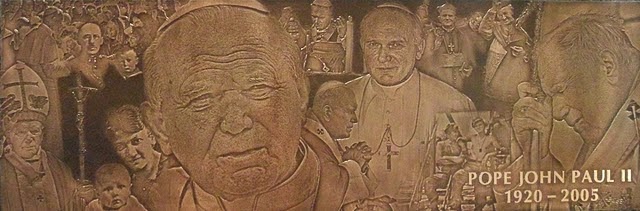
At his funeral in St. Peter's Square in 2005, there were prolonged chants from the multitude gathered for “Santo Subito” (Sainthood Now!). On April 27, 2014, the Catholic Church celebrated the canonization of the 264th pontiff Pope St. John Paul II (born Karol Józef Wojtyła) along with the 262nd Vicar of Christ Pope St. John XXIII (ne Angelo Giuseppe Roncalli) in St. Peter's Square in Vatican City.
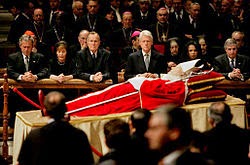
Three American Presidents paying respects to Pope John Paul II, April 2005
Some Protestants bristle at the notion that the Church “makes” saints, as nobody (but Christ) is perfect and that we are all supposed to be called to sainthood in our Christian identity. Certainly our baptism marks us as part of the Lord’s people and calls us to holiness. The Catholic Church can recognize, based on investigation and guidance from the Holy Spirit, that a person is already a saint, definitely in heaven and having led a life of great holiness that is worthy of veneration by the faithful. Canonized
saints are important examples to the faithful of how to live a heroic (not perfect) Christian life.
Pope John Paul II was a remarkable man who wore many hats in his life. He was a Laborer, Thespian, Playwright, Patriot, Priest, Philologist, Philosopher, Pilgrim, Bishop, Theologian, Sportsman, Scholar, Statesman and Vicar of Christ. The cause for John Paul II's canonization however is not premised on doctrinal dissertations, academic accolades or even geopolitical accomplishments.
It is about how John Paul II lived his life to reflect the Christian virtue which still touches the faithful today.
After several years of investigation led by postulator Monsignor Slawomir Oder, the Vatican’s Congregation for the Causes of Saints recommended Servant of God John Paul II’s heroic virtue to the Pope. On December 19, 2009, Pope Benedict XVI proclaimed John Paul II as “Venerable”. The Church normally requires that one miracle is attributable to intercessions of a Venerable, but the Vatican only investigates possible miracles after a candidate is declared Venerable. These miracles are almost always miraculous medical cures as these are the easiest to verify.
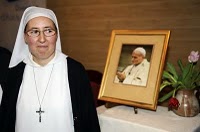
Sr. Marie Simon Pierre
Sister Marie Simon Pierre, a nun from the order of Little Sisters of the Catholic Motherhood in Aix au Province, France, had suffered with Parkinson’s Disease, like John Paul II, for four years. She intensely prayed along with her community for healing through the intercession
of John Paul II only two months after John Paul II’s death. Doctors determined that Sr. Simon Pierre’s neurological symptoms had disappeared inexplicably. This was deemed John Paul II's first miracle in 2011.
[***]
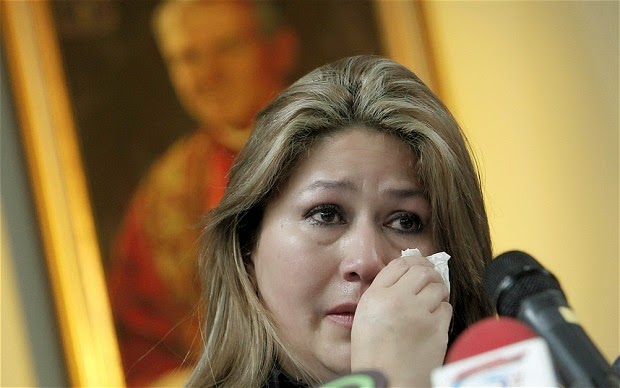
Floribeth Mora Diaz
In April 2011, Floribeth Mora, a 50 year old
Costa Rican grandmother, was diagnosed with an inoperable brain
aneurysm and was sent home to die. But on the day of John Paul II's
beatification, Mora saw a photograph of John Paul II and the photograph spoke to her saying "Get up" and "Be not afraid". Remarkably, her aneurysm disappeared that same day. Neuro-surgeons in Rome could not medically explain the disappearance. This miracle satisfied the Congregation for the Causes of Saints in the Vatican.
[***]
The date of the canonization may well have been chosen because it was the 2nd Sunday of Easter, which Pope John Paul II instituted during his Papacy as “Divine Mercy Sunday”, due to his Devotion to St. Faustina Kowalska (1905-1938). The vigil mass of the feast of Divine Mercy had just been celebrated at John Paul II’s bedside when he fell into a coma and soon after died.
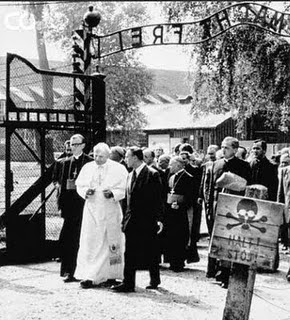
Pope John Paul II at Auschwitz (1979)
The date of John Paul II’s canonization also occurs on National Holocaust Rememberance Day in Israel and during the March of the Living where people gather in in Krakow, Wojtyła’s home for 40 years, to march between the Nazi death camps of Auschwitz to Birkenau to remember the Holocaust. John Paul II had strong connections with the Jewish community in his childhood home off Wadowice, where ¼ of the town’s 8,000 residents were
eradicated for anti-Semitic aspirations of Nazi racial purity. These
events strongly influenced John Paul II’s weltanschauung, since during his
pontificate, John Paul II made great strives to acknowledge the sin of
anti-semitism, especially in the Holocaust, and to strengthen the Church’s
relations with the Jewish Community. In May 1998, Pope St. John Paul II gave a formal apology about Catholic shortcomings in the Holocaust in the proclamation "We Remember: A Reflection of the Shoah".
[***]
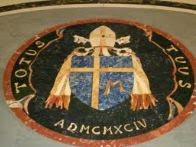
Then Cardinal Karol Wojtyła was elected Pontiff in October 1977 during the Year of Three Popes. While Pope John Paul II was the first non-Italian pope in 454 years and was from a nation behind the Iron Curtain, he was chosen because of his theology. John Paul II chose as his papal motto “Totus Tuus”, which reflected his Reflected his personal consecration to Mary which was based on the spiritual approach of St. Louis de Montfort (1673-1716)—“Totus
tuus ego sum, et omnia mea tua sunt" ("I am all yours, and all that I have is yours"). In Crossing the Threshold of Hope, he explained that the “Totus Tuus” motto expressed the understanding that he “[c]ould not exclude the Lord's Mother from my life without neglecting the will of God-Trinity”. Polish born composer Henryk Gorecki (1933-2010) wrote the choral
piece “TotusTuus” in honor of Pope John Paul II’s 3rd visit to Poland in 1987.
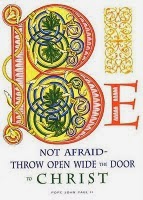
From the start of his Petrine ministry until his eventual death from Parkinson’s Disease 26 ½ years later, John Paul II’s message to the faithful was the Lucan exhortation “Be not afraid”. In fact, John Paul II uttered the phrase three times during his homily at the Papal Inauguration. This message “Be not afraid… open the door wide to Christ” was chosen as the slogan for his beatification.
It was the same message that he brought when he first visited his homeland of Poland in June 1979. The documentary Nine Days That Changed the World showed the power that John Paul II message of “Be not afraid” had with the Polish people to instill the dignity of the individual to live out their faith and, with the guidance of the Holy Spirit, renew the face of the Earth and their land.
The millions of Poles who flocked to their favorite son's first pilgrimage back to his homeland showed that the faithful were not alone in that officially atheistic state and served as a real retort to Stalin’s taunt of “The Pope! How man divisions does he got?" Both Lech Walesa, the piously Catholic worker who lead
the Solidarity movement (and eventually became Poland’s President), and Vaclav Havel, the less spiritual leader of a free Czechoslovakia, credit the fall of the Iron Curtain to the message “Be not afraid” embodied in John Paul II’s 1st visit to Poland.
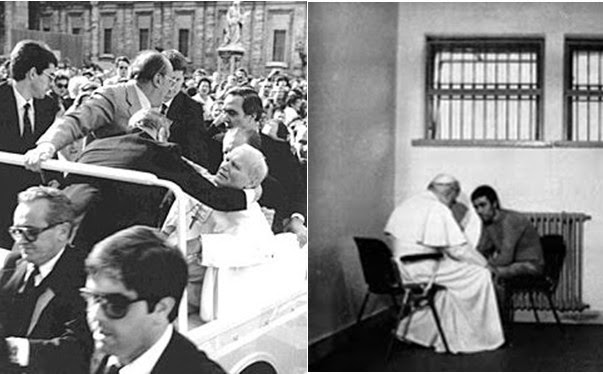
OnMay 13, 1981, Pope John Paul II was shot four times at close range and critically wounded in St. Peter’s Square by Mehmet Ali Ağca, a trained Turkish gunman. Many belief that this assassination attempt was a hit job coordinated by the Bulgarian
Secret Police with the complicity of the Kremlin. Yet less than two and a half years later, John Paul II met with Mehmet Ali Ağca and forgave the gunman on Christmas, 1983.
[L] Pope John Paul II shot May 13, 1981, [R] Pope forgives Agca December 25, 1983
Pope St . John Paul II was convinced that Our Lady of Fatima kept him alive during the ordeal where he lost 3/4ths of his blood.
The Third Secret of our Lady of Fatima can be seen as predicting the assassination attempt on the Pope. The John Paul II’s
faith filled connection between his assassination attempt and the visions of Fatima that a bullet from his wounds now tops the golden finery of the Our Lady of Fatima processional statue.
One of the hallmarks of Pope St. John Paul II’s reign was being a Pilgrim as Vicar of Christ to proclaim Jesus as the Redeemer of Humanity to all the Earth. Frankly, he came pretty close to covering it all. It is speculated that the curia spent about a fourth of their time planning for and executing his 104 foreign trips to 125 countries which totaled 725,000 miles.
[***]
At the behest of Pope St. John Paul II, World Youth Days were held every couple of
years at rotating international locations. Skeptics certainly questioned in
disengaged youth would care about such events, but the youth loved to rally
around the Pope and open themselves to the new evangelization. The
vitality of World Youth Day tradition has not subsided in the loss of
John Paul II. These large conclaves of young people meeting to renew
their faithful inclinations echoes how John Paul II loved to channel the energy
of crowds in a positive manner to allow people to feel connected in a vibrant
and visceral way. [***]
While Pope Benedict XVI did not formally recognize John Paul II as a martyr in his
beatification mass, many feel that the manner in which John Paul II lived with his debilitating disease and how he died with dignity in the Vatican was exemplary. His final words were uttered in Polish "Allow me to depart to the house of the Father". John Paul II had run the good race and was not afraid to go home to the Father by extending his life through extraordinary medical procedures for terminal illness.
In addition, Pope St. John Paul II left a large body of theology during his long pontificate, which will have a long lasting influence upon the Church. [***] Many feel that Pope St. John Paul II will be best remembered for his "Theology of the Body", which was based on 129 lectures from his Wednesday audiences, which focused on Christian marriage, celibacy and virginity, contraception and the sacrament of marriage.
Pope St. John Paul II's example of the new evangelization, his example of forgiveness and fearlessness for standing up for the faith certainly gives the model to “Be Not Afraid” in our own paths toward being part of the Community of Saints.
Today is the feast of Our Lady of Guadalupe, the Patroness of the Americas and of Mexico.
In the 1640s, a peasant named Juan Diego was walking between his village and Mexico City and he saw a vision of a girl approximately sixteen years old surrounded by light on Tepeyac Hill. Speaking to him in Nahuatl, the local language, she asked Juan Diego that a church be built on Tepeyac Hill in her honor. Juan Diego recognized the vision and the Virgin Mary. The Bishop instructed Juan Diego to return to Tepeyac and ask the lady for a miraculous sign to prove her identity. The visage instructed Juan Diego to gather flowers from the top of Tepeyac Hill. The usually barren Tepeyac Hill was blooming in Castilian roses, which were not native to Mexico. Juan Diego gathered the roses which the Virgin arranged in his tilma cloak. When the peasant opened the cloak before the Bishop, the flowers fell to the floor and an image of the Virgin of Guadalupe was miraculously imprinted on the fabric.
Pope John Paul II canonized St. Juan Diego Cuauhtlatoatzin in 2002. And in 1999, Pope John Paul II elevated Our Lady of Guadalupe to a Solemnity in all of the Americas.
The iconography of the image of Our Lady of Guadalupe was understood as being the Woman of the Apocalypse from Revelations 12:2 "clothed with the sun, and the moon under her feet, and upon her head a crown of twelve stars”. Yet there are hermeneutical images that appealed to indigenous Americans too. The Lady’s blue-green mantle was a hue reserved for the divine couple Ometecuhtli and Omecihuatl. A cross shaped image below the sash is the nahui-ollin and indicates the cosmos. The rays of light look like maguey spines, the source of the sacred beverage pulque (and tequila). Moreover, Many understand the black girdle along the Lady’s belt to indicate pregnancy, so Our Lady of Guadalupe is also unofficially considered the Patroness of the Unborn to the Pro-Life movement.
The rose amidst winter’s cold is an image of Advent which is not isolated to Our Lady of Guadalupe. A Spotless Rose is a 15th Century German carol.
A spotless Rose is blowing,Sprung from a tender root,Of ancient seers' foreshowing,Of Jesse promised fruit;Its fairest bud unfolds to lightAnd in the dark midnight,Amid the winter cold,A spotless Rose unfolds.
The Rose which I am singing,Whereof Isaiah said,Is from its sweet root springing,In Mary, purest Maid;For, through our God's great love and might,And in the dark midnight,Amid the winter cold,The blesse`d Babe she bare.
Although both the Eastern and Western Churches have ascribed to the sinless conception of Mary the Mother of God, it dogmatically proclaimed as the Immaculate Conception until the 1854 ex cathedra papal bull Ineffabilus Deusby Pope Pius IX.
Due to unclear contemporary catechesis, a minimization of Mariology and its place on the liturgical calendar near the start of Advent, the Solemnity of the Immaculate Conception can be mistaken as the sinless conception of Jesus rather than His mother Mary. As a child of Vatican II, I struggle with mystagogical necessity of the Immaculate Conception--how can our sinless savior be born from a Mother with sin? Nevertheless, I accept it as a mystery of faith which I may not wholly appreciate but that I believe.
Perhaps a better way to understand the Immaculate Conception is through an Eastern approach. On December 9th, Orthodox Christian Churches celebrate the Conception of the Most Holy Theotokis by St. Anne. Celebrating St. Anne should have significance to the City of Detroit, which the Vatican named as its patroness in 2011.
One of the common synonyms for Mary the Mother of God is as Theotokis or god-bearer. To me, that semantical construction god-bearer calls to mind the Ark of the Covenant from the Book of Exodus, where God dwelled among His people. This is rich with symbolic significance and points to our Savior.
Typically we think of the Immaculate Conception as Mary, the Mother of God, being born without sin (the unblemished Tabernacle for the Incarnation). That being said, it seems more useful to consider Mary as being full of the Holy Spirit. So rather than focusing on herself, she could magnify the Lord through her son Jesus Christ.
So to celebrate the Conception of the Theotokis by St. Anne and its consequence, we can reflect upon portions of the Orthodox Divine Liturgy as scored by Arvo Part.
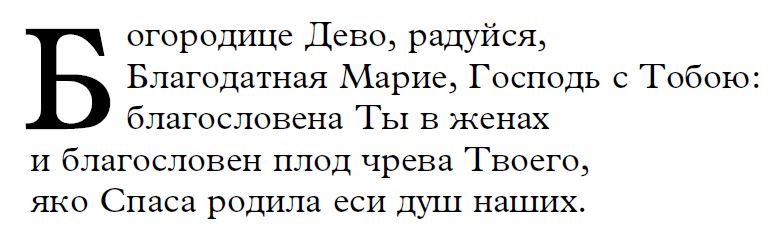
Rejoice, O virgin Mary, full of grace, the Lord is with thee: blessed art thou among women, and blessed is the fruit of thy womb, forthou hast borne the Saviour of our souls.
Today is the start of the new liturgical year for the Roman Catholic Church. It also marks the first Sunday of Advent for the Latin Church (other Eastern Churches started a fortnight beforehand). In our secular society, we can be tricked into thinking that the Advent calendar is only a countdown for Christmas shopping. But scripture during Advent reminds us of the dual nature of the season: to prepare for the cyclical celebration of Our Lord's birth as well as Parousia (the Second Coming). The Lectionary during Cycle A features Isaiah's prophetic vision (IS 2:1-5) when God reigns Supreme and swords are hammered into plowshares and spears into pruning hooks. Daniella Zsupan-Jerome, a professor of liturgy at Loyola University in New Orleans, uses a detail of Michelangelo's Sistine Chapel to illustrate the scripture.
The Gospel (MT 24:37-44) alludes to the Second Coming where Jesus exhorts the faithful to be prepared as Noah was for the Flood. This is sobering "Good News" but it should help lead us with our walk with the Lord, especially in this period of preparation. The Isaiah panel on the Sistine Chapel prompts a ponderous thought. Zsupan-Jerome wondered if position of Noah's Ark about Isaiah prompted the prophet to think of Mount Ararat, where Noah's Ark landed, as he handed the vision of God's Holy Mountain? This would lend the aspiration that man should seek God's holy mountain to, borrowing a phrase from the Responsorial Psalm (PS 122), "dwell in the House of the Lord." The Noahide Covenant established that the Lord would not destroy humanity through a flood. The Messiah's admonition to be prepared has some soothing subtexts rather than relying upon our own inadequate righteousness. The name Jesus can be translated to "Yahweh Saves". Moreover, the Lord so loved the world, He sent His only son to be born of this world in all things but sin and be an intregal part of our salvific history. As we come into this season of devout and joyful expectation, it would behoove us to consider the nuances, hermaneutics and deeper meanings of Advent, as expressed through art, scripture and the easily overlooked holiday trappings. h/t: Loyola Press


 According to Dominican tradition, St. Dominic (1170-1221) founded the Rosary in 1208 as a meditative prayer which sought to spiritually combat the Albigensian heresy (which believed that only spiritual realities were good and vehemently opposed God taking flesh in Jesus Christ). But this meditative Marian prayer featuring just the Angelic Salutation and the Evangelical Salutation fell into disuse during the 14th Century during the era of the Black Death in Europe.
 In the mid 15th Century in a Dominican monastery in Brittany, Alan de la Roche experienced visions from the Blessed Virgin Mary and the Lord which eventually convicted him to revive and renew the Dominican Rosary. De la Roche was not the perfect emissary for this divine mission. At one point, Jesus appeared to De la Roche and said: "You have all of the learning and understand that you need to preach my mother's rosary, and you are not doing so. The world is full of devouring wolves, and you, unfaithful dog, know not how to bark." The latter phrase was a pointed wake up call to a Dominican like Blessed Alan, as the Order of Preachers held the moniker "Dog of God" (Latin domini canus which sounds similar to Dominicanus)
 Although Blessed Alan wrote an instructional pamphlet Book and Ordinance regarding the renewal of the Dominican Rosary, about 1/3 of the Vatican documents were lost after Napoleon sacked the Vatican archives from 1810-1813. So much of quotable material about Blessed Alan comes from St. Louis de Montfort (1673-1716) whose 18th Century works True Devotions to the Blessed Virgin and The Secret of the Rosary were buried in a field in France for over 125 years, thereby escaping the irreligious impulses of the French Revolution.