Thursday, 2 June 2011

Feast of the Ascension of Our Lord

Some parts of the world are celebrating the Feast of the Ascension of Our Lord today whilst others, including England and Wales, have to wait until Sunday. However, depending on the outcome of consultation and reflection by the Bishops of England and Wales, the celebration of the Feast of the Ascension as a Holy Day of Obligation in England and Wales might revert to its proper place within the Easter season. Which ever day you are celebrating it, Sister Wendy Beckett offers the following reflection.

The forty days after the Resurrection of Jesus must have been the most extraordinary period in Christian history. Once the Apostles had finally come to terms with the overwhelming miracle of His Presence, every day must have held out the ecstatic possibility of His appearance. We are told that, "He appeared to many". Mary Magdalene knew well that this state was only temporary, but perhaps there were those among the Apostles who persuaded themselves that He would be among them always, visible and beautiful. It was not to be. He remained on earth long enough to make it inescapably clear that He was alive – more than alive – transcendently alive. But while He was physically visible, His power was limited. He could not send the Spirit, He could not be alive in their hearts, until their knowledge of Him sprang from faith and not from sight.

This is a very early icon showing that climactic moment when Jesus said farewell in the flesh, and ascended into heaven. Western art has always been challenged by the sublimity of this image, and usually shows Mary and the Apostles, looking upwards, while there are only two feet appearing below the upper edge of the painting. For the Orthodox, this is lacking in respect. This is a damaged icon, but the image will be repeated over the centuries. Jesus is central, held in an oval mandorla of glory, the most eye catching element in the icon. This is what we notice above all, Jesus, ascending heavenwards. Translucent angels bear him up. Soon He will disappear from sight, and only the eyes of faith will see Him, interiorly, within the heart.

Meanwhile, on earth, Mary stands astounded, lifting up her hands in praise and wonder. On either side the Apostles look upwards, bewildered, bereaved but believing. Mary does not need to look upwards. Naturally, she will miss her Son, but supernaturally she understands that this is how it must be. It is how He will draw all to Himself. He is set free from the limitations of time and place. "He has ascended to His Father". Most later icons add further elements to the story. When the Apostles got over their shock, they found "two men in white robes" rebuking them for their folly in gazing up into the heavens. Jesus will come again, they told them, but only on the last day. Meanwhile, Christians were meant to get on with life, and to live in the Spirit of Jesus, rather than hankering after His material presence. Perhaps the iconographer imagined that two of the angels, so blissfully bearing Jesus upwards, would then come down to the earth, to give sound advice to His rather hapless followers.

There are very few early icons of Jesus that survive. We are privileged to possess this image of our Blessed Lord held between heaven and earth. His garments are gilded as opposed to the earthy clothing of His mother and His Apostles. He stretches out a hand in final blessing, while His other hand holds the rolled parchment of His teaching. That teaching has yet to be written down, to comprise the Gospels and, through His union with Jesus, the letters of St Paul. There might seem to be two worlds here, the eternal world of Jesus, and the temporal world of Mary and of her anxious supporters. But the whole icon is lit with an inner glory, showing us that in Jesus heaven and earth are one.

Picture: copyright St Catherine’s Monastery, Mount Sinai.
Text: copyright ST PAULS Publishing Sister Wendy Contemplates the Iconic Jesus.
Posted by ST PAULS Bookshop

Tuesday, 31 May 2011

Who am I that the Mother of my Lord should visit me?

We can all echo the words of St Elizabeth, for surely we who have recourse to Mary have felt the embrace of Our Heavenly Mother at times of trouble and grief?
 I have turned to Mary, Our Lady of sorrows and she has comforted me because Her Son died too.
In times of joy she shares our happiness because she rejoiced at the goodness of God and the wonder of His Blessings.
When I am troubled by worries I look to the image of the  Icon of Vladimir on my wall..Our Lady Mother of Tenderness, embracing Her Beloved Holy Son and her eyes of love and tenderness calm my soul and point me to Jesus.I thank God for Mary.
Theotokos of Vladimir

The Imitation of Christ - the perfect book for the soul!

‘The Imitation of Christ’ by Thomas a Kempis may be the best selling book in the world next to the Bible but it’s surprising how many Catholics either have not read it or, even, heard of it.


This is a shame as, in my view, it is quite one of the most inspirational books you will ever find. Open it at any page and you will find a passage that is appropriate to your circumstances.
It is simple to absorb and fascinating to follow as it maps out the path of a follower of Christ with all its turns and dead ends, its peaks and its troughs, triumphant always, in humility, love and faith.

Thomas a Kempis was born in 1379 to John and Gertrude Haemerken of Kempen, a small town close to Cologne. Leaving home he went to join his brother, Jan at a school in Deventer but, upon arrival, he found that Jan had left to found a congregation of Canons Regular at Windesheim. Thomas immediately travelled to Windesheim to see his brother and, upon his recommendation, returned to Deventer to enter the community of Brothers of the Common Life. This order required no vows of its followers, merely an adherence to an inner life, a disregard for income and a desire to work within the community, either physically, or more often, teaching and carrying out pastoral duties.

His early priestly life is described in this extract from New Advent

At Deventer Thomas proved an apt pupil, already noted for his neatness and skill in transcribing manuscripts. This was a life-long labour of love with him; in addition to his own compositions he copied numerous treatises from the Fathers, especially St. Bernard, a Missal for the use of his community, and the whole Bible in four large volumes still extant. After completing his humanities at Deventer, in the autumn of 1399, with the commendation of his superior, Florentius Radewyn, Thomas sought admission among the Canons Regular of Windesheim at Mount St. Agnes, near Zwolle, of which monastery his brother John was then prior. The house had been established only the previous year, and as yet there was no claustral buildings, no garden, no benefactors, no funds. During his term of office, which lasted nine years, John à Kempis built the priory and commenced the church. In these circumstances we find the explanation of the fact that Thomas was not clothed as a novice until 1406, at which date the cloister was just completed, nor ordained priest until 1413, the year after the church was consecrated. The point is worth noting, as some writers in their eagerness to discredit the claims of à Kempis to the authorship of the "Imitation" have actually fastened upon the length of this period of probation to insinuate that he was a dullard or worse. Thomas was himself, to within a few months of his death, the chronicler of Agnetenberg. The story which he tells of the earthly struggles of the priory on the mount, its steady progress, and eventual prosperity is full of charm and edification ("The Chronicle of the Canons Regular of Mount St. Agnes", London, 1906). These records reveal to us the simplicity and holiness of his religious brethren. He was twice elected subprior, and once he was made procurator. The reason assigned by an ancient biographer for the latter appointment is one that does honour both to Thomas and his brethren, his love for the poor. However, we can scarcely imagine the author of the "Imitation" a good business manager, and after a time his preference for retirement, literary work, and contemplation prevailed with the Canons to relieve him of the burden. The experience thus gained he made use of in a spiritual treatise, "De fideli dispensatore".

Thomas a Kempis - yet to be made a saint

The Imitation of Christ is really a dialogue between Christ and us. We are told not to take the good things in our life for granted; our health, our family and friends, our careers and temporal luxuries. All belong to Christ, we have no rights over any of them, therefore, it is not our due to mourn their loss. We are  rather like a thief who, having robbed a rich haul of goods, then has them whipped away from him by another hand. He has no right to feel a sense of loss.

But then, swiftly we are told that we only have to call on the name of the Lord to have restitution, albeit a spiritual restitution.
Trying to pick on a particular chapter as an example is a fruitless task; all are so apt, all are so profound. If you have a bereavement, lost a friend, contracted an illness, been thrown on life’s scrapheap…look in this book and you will be revived and refreshed. Rejuvenated, even.

Here are one or two passages that reflect the spirit of this most precious book:-

“CHRIST’S OFFERING ON THE CROSS AND OUR SURRENDER OF OURSELVES”

The Voice of the Beloved: I freely surrender myself to God the Father for your sins, with my hands spread out on the cross and my body stripped. I kept nothing back, but let all be transformed into a sacrifice to appease the divine anger. And every day in the Mass, you too of your own free will should offer yourself to Me as a pure and holy offering with all your powers and affections, from the very depths of your heart.
I ask nothing more of you except that you should want to surrender yourself entirely to Me. I do not care what you give Me besides yourself, because I do not want your gifts, but you.
If you possessed everything except Me, you would not find satisfaction. In the same way, nothing you can give Me can please Me if you do not give yourself.
Give yourself to Me. Offer yourself wholly for God’s sake, and your offerings will be accepted. Think of this – I offered Myself wholly to the Father for your sake. I even gave My whole Body and My Blood to feed you, so that I should be entirely yours, and you should be kept Mine…..

And…..

“A WARNING AGAINST EXCESSIVE DEJECTION WHEN LIFE SEEMS TO GO WRONG”

….I am still living, says the Lord, and I am ready to help you and comfort you more than you have ever known, if you trust Me and call on Me devoutly.
Take things more calmly, and brace yourself to endure things better. Everything is not ruined if you often find yourself in difficulty and facing strong temptation.
You are man not God. You are a mortal creature, not an angel. How could you possibly maintain an unchanging state of virtue when it proved impossible for the Angels in Heaven and for Adam in Paradise? It is mine to comfort the mourner with new hope, and it is those that know their own weakness that I raise to my divinity……

If you do not posses a copy of the ‘Imitation of Christ’ I recommend that you buy a copy…not one from pre 1960 or post 1980 as the language used in both is less easy on the eye and less beautiful even.
It will be the best purchase you will have made in a long time.

Posted by Richard Collins – Linen on the Hedgerow

Happy Feast of the Visitation to all members of the Guild and its friends and followers

Fra Angelico

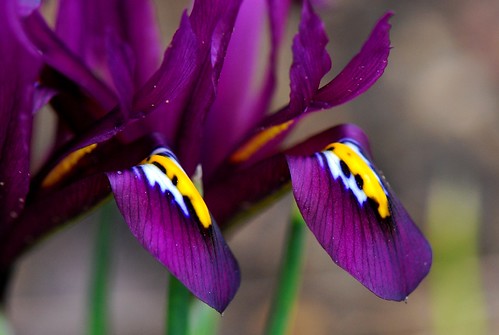
The Visitation and the Iris:
The ancient Egyptians considered the Iris as a symbol of eloquence, and placed the flower on the brow of the Sphinx and on their kings' sceptres, the three leaves  representing faith, wisdom and courage. In the Mystries of the Annunciation and the Visitation, Mary demonstrates all four attributes: wisdom in her reaction to Gabriel, faith and courage in her acceptance of his message, and eloquence in her 'Magnificat'. In Christian Art, the flower came to represent the Queen of Heaven and her Immaculate Conception, calling to mind that Mary could not have been Queen of Heaven unless she had been immaculately conceived, nor could she have become Christ's mother without that conception.

Purple Iris Reticulata:
In the work of the early Flemish  artists there is rivalry between the iris and the lilly for the name 'flower of the holy Virgin'.But perhaps the iris has the edge because its sword-shaped leaves gave it the added symbolisam of the sword that was to pierce Mary's heart. There is a medieval monastic legend that echoes this: at the death of Jesus, all nature grieved and a dead silence fell upon the earth. Only the plants still whispered and the iris said, 'Dark violet will forever be the mourning colour of my flowers.'


Iris 'Rosario: The Visitation is a joyful Mystery of the Rosary, and indeed in parts of Italy the roots of the bearded iris were used to make rosary beads. I do not know whether this is still the case, or whether this cultivar is named for the Rosary, or because of the slight pink tinge of its petals in some lights.

The iris is named after one of the Greek messengers of the gods who travelled along the rainbow between heaven and earth in order to deliver the commands of the gods to the people. Her veil contained the colours of the rainbow, and she came to be thought of as the personification of the rainbow itself.  And in spite of the later Christian legend, the iris indeed blooms in almost all the colours of the spectrum. Later Iris was believed to bring the souls of women and children to the land of everlasting peace, taking the latter group into her lap. In this personification and action she was regarded as the connection between heaven and earth. This mythology is clearly the reason why the iris has come to signify a message, and usually a good one, in the Language of Flowers. And it is easy to see how these attributes of  Iris were Christianised, as they applied so clearly to Mary in her role as messenger to Elizabeth at the Visitation, and to her role as mother of us all. We continually ask her to pray for us 'now and at the hour of our death'.

(Note: The difference between the Blessed Virgin Mary and Iris is obvious.Our Lady is real. She has a human history and a heavenly reality and throughout the centuries has never ceased to be our Mother, never ceased to bring us the messages we ignore at our peril; Iris is a myth, dreamed up by the human spirit longing for certainty in the Divine. And yet the same human spirit is programmed to search for that certainty. It was opened up to us at the Incarnation when God sent his Son into the world through the fourfold virtue of the Immaculately conceived Virgin Mary whom He had created.)

Above all I think of the Visitation as full of joy, the joy of Mary, the joy of Elizabeth and of the unborn John within her womb. But it is an occasion of our joy too, because Mary is bringing Christ to us. The mystery of the Visitation foreshadows the coming of Jesus into our lives and the union of our souls with Him. So that we can all ask with Elizabeth, 'Who am I that the mother of my Lord should come to me?' As Maisie Ward put it: " Our Lord in this mystery has not only taken a human nature from Mary but has left Himself helpless, powerless in the darkness of her womb to be taken where she wills. Even so , it is the beginning of the divine economy of grace whereby God saves mankind by giving HIMSELF into the power of mankind. The Cure d'Ars, marvelling over the Blessed Sacrament, said, 'I bear Him to the right and He stays to the right; I bear Him to the left and He stays to the left. ' " ('The Splendour of the Rosary' Sheed and Ward 1948)

Meditation on the Magnificat is an appropriate way to end Mary's month, but at any time it proves an inexhaustible well for such reflection. For instance, to magnify and to rejoice in God is the beginning of realisation of our own nothingness: Mary would be called blessed by all generations because of her humility, and only to the humble can God entrust His gifts; and later Our Lord blesses those who hunger and thirst after justice. Here, Mary's Magnificat points the way to a solution for our social problems and to true Christian living.

Our Lady in the Magnificat Garden

Envoi:

Breath of Heaven,
Carry us on the impulse
Of Christ's love,
as easily as thistledown
is carried on the wind;
that in the Advent season of our souls,
while He is formed in us,
in secret and in silence
the Creator in the hands of his creatures
as the Host
in the hands of the priest -
we may carry Him forth
to wherever He wishes to be,
as Mary carried Him over the hills
on His errand of love,
to the house of Elizabeth.

(Caryl Houselander 1901- 1954)

(copyright Jane Mossendew 'The Crown of the Yeaar' 2005 The Houselander poem is quoted with permission therein.) 


This is my last post for a while. Aside from everything else, still haven't really recovered from the trip to Rome for the Blogmeet. Need to recharge spiritual batteries. Hope to be back in about a week. 


Monday, 30 May 2011

The Visitation of the Blessed Virgin Mary: Eve of the Feast


Although it celebrates a gospel account, the feast did not become universal  until the fourteenth century, when Pope Urban VI established it on July 2 as a continuation of the former octave of the birthday of St. John the Baptist, which certainly had things the wrong way round! The date of the feast is now more logical, separated from St. John's birthday by almost a month, thus symbolising the three months that Mary is said to have stayed with Elizabeth (Luke 1:56). And had the Visitation not replaced the Queenship of Mary (which has been moved to August 22 under the adjusted title of 'Our Lady Mother and Queen'), we would have no Marian feast in May. This would have been odd since May is traditionally regarded as one of Mary's special months (the other being October)

Around 1868 an Italian Father of Charity, Doctor Gentili, introduced the celebration of May devotions among the English. This was probably the result of Pope Pius IX having introduced the granting of a plenary indulgence to those who practised devotion to Mary during May, with the usual proviso that they went to Confession and Communion. This is certain to have appealed to English Catholics, whose country had been known as 'the Dowry of Mary' since at least 1399.. In that year Archbishop Arundel of Canterbury published a mandate that included the words, 'But we, as the humble servants of Mary's , and liegemen of her especial dower - as we are approved by common parlance -  ought to excel all others in the fervour of praise and devotion to her.'

Pray for us, natives of England thy Dowry

Fr. Mark Elvins (in his 'Catholic Trivia', Harper Collins Religious 1992) is persuasive that the term goes back further, and that the young Richard II , in thanksgiving for the ending of the Peasants' revolt, had solemnly consecrated his kingdom to Mary after his successful meeting with Watt Tyler and his rebels, on the Saturday after Corpus Christi in the year 1381.
(copyright Jane Mossendew the Crown of the Year 2005)

 
Tomorrow at 7.50p.m. UK time kto tv will broadcast direct from the Lourdes Grotto in the Vatican gardens when the Pope makes his annual visit to formally close the Marian month of May. Meanwhile in England:

The Slipper Chapel, near Walsingham


(I chose the Iris to celebrate the Visitation and will post teat extract tomorrow.)
Posted by Jane - Thoughts from a catholic Oasis

Magnificat in Sixth Tone Orlando di Lasso_0001.wmv

Magnificat (Tone 2, D, g.)

Sunday, 29 May 2011

The gift of the Holy Spirit

“Announce with a voice of joy, and let it be heard to the end of the earth.” (Is 48.20) As we come towards the end of Eastertide, the Church invites us to ponder the gift of the Holy Spirit Who was given by Christ to the Apostles, and, after them, to all of us.

The Holy Spirit is the third person of the Blessed Trinity, truly God and co-equal with the Father and the Son. We particularly appropriate to the Holy Spirit the wisdom and the love of God. When we are in a state of grace (free from mortal sin) the Holy Spirit dwells in our soul to sanctify us.

In preparation for our Confirmation, we learnt of the gifts of the Holy Spirit and the fruits of the Spirit that show His life in us. Over and above the human virtue of prudence, the Holy Spirit assists us with supernatural wisdom, understanding, counsel, and knowledge, leading us to a fitting fortitude, piety and fear of God.

The primary grace of the sacrament of Confirmation is the grace for strengthening (gratia ad robur). This applies not only to our interior life of grace but especially to the witness that we give to others. This witness may often require fortitude as well as wisdom and right judgement.

We should know the traditional prayer to the Holy Spirit and use it often. Faced with an important decision or even something as mundane as a meeting, we do well to call upon the Holy Spirit to make us truly wise, to enlighten us, to kindle in us the fire of His love, and to send us His holy consolation.

Fr Tim Finigan The hermeneutic of continuity

Saturday, 28 May 2011

"With desolation is the land made desolate because there are none who thinketh in their hearts."

Excerpt from the chapter, The Dawn of Truth ( from his book Sobriety and Beyond) by Father Ralph Pfau. (Imprimatur Paul C Shulte D.D Archbishop of Indianapolis March !955).In 1948 Fr Ralph founded the National Clergy Conference on Alcoholism, an organization devoted to the problems of priests, and directed it for many years. Its publications, especially "Alcoholism Source Book for Priests," and the annual "Blue Book," made a deep impact on the American Catholic Hierarchy.

I have inserted capitals as Father Ralph (pictured above) uses them, in his book. The three choices he suggests at the end, I believe I have attempted all three more than once. I am able to continue attempting No.3 ..............and I surely know that this is but for the grace of God. I find Father Ralph's words so healing! That is why I share them. I have posted this excerpt on my own blog today and thought it might be of interest generally.

"Somewhere along the path of life of every human being there comes a dread moment when he suddenly sees himself for what he is. Minus all the sham, the surface and the show, he then stands face to face with truth. Minus the deception of his own self seeking and selfishness, he sees himself clearly outlined in the aura of God's grace as it tears away all the foolish self deceptions and shows a man for what he really is- selfish, deceitful, full of excuses, dishonest, even to himself and full of faults and failings............conts: To most of us, this moment comes at a time when many of life's battles and years have passed, but at a time when there still remains sufficient years, vigor and initiative to "seek truth and pursue it,".in order to make it the motive of our living, the motive of our struggles and the security of our declining years.

This moment may be brought about by the death of a loved one, the loss of worldly goods, or it may be directly occasioned within by the grace of God speaking to the depth of our soul. To most alcoholics it comes at that instant when they face the inevitable choice: death, insanity or absolute sobriety. It often comes with a blinding flash that seems to tear away the very foundations of life and whether alcoholic or non-alcoholic, layman or professional, young or old, there arises from the very innermost sanctuary of the soul and heart the cry "My God, what a mess I have made of things! How pitiful is the good done, how sparing my help to others, how innumerable my mistakes, the wrongs-how all pervading my self seeking, how dishonest my every motive! How seamy the finished, but now battered product!"

This "moment" may last for an hour, a day, a month, a year or for years. But whenever, however it comes- it is a dread and fearful moment, because UPON THAT MOMENT AND THE DECISIONS OF THAT MOMENT MAY DEPEND OUR VERY LIFE AND OUR ETERNITY. And from that time on, one can never be the same again.....................conts: It is then that life's greatest decision must be made and then it seems that an angel has him by the hands and a devil by the foot...............he can do one of three things:


First, rush in confusion back to the old surface view of self and try by a thousand and one half remdies to dress up the haunting vision, to explain away the stubborn reality. TO EXCUSE and to attempt forgetfulness by courting the sham fancies of the night and by rushing headlong through the chores of the day. THIS IS THE CHOICE OF THE VAIN MAN.

Second, the shock may be so great, the failure so undeniably real, the disillusionment so crushing that he despairs and in one way or another he seeks to destroy himself- either factually or by the bottle. THIS IS THE PROUD MAN.

Third, this is the way of the Prodigal Son, who dropped on his knees in the swine pen and cried: "Father, I have sinned" or with it's echo "I am powerless... my life is unmanageable"- and perhaps for the first time in his life that man REALLY prays and begins to MEDITATE, THIS IS THE HUMBLE MAN. And day by day he prays and he MEDITATES on TRUTH lest again he fall back into his former life-long HABIT OF EXCUSES. For the LIFE OF ALL IS LOADED WITH EXCUSES-AND SYSTEMATIC, PERSISTENT AND CONSISTENT MEDITATION ALONE WILL DISSIPATE THEM. "With desolation is the land made desolate because there are none who thinketh in their hearts.""

posted by shadowlands @ http://shadowlands1.blogspot.com/

Friday, 27 May 2011

From 2009: St Therese of Lisieux

I always wait to be inspired to write or post and while I was wondering what to put for my first post on the Guild Blog ,this memory came ,thank you Saint Therese.You never fail me.I hope the other guild members don't mind me re posting something from my own blog,but this just felt right. The visit was an amazing experience,  it wasn't an ornate box of bones we met in Cardiff it was a smiling and loving person.

Our visit to the Little Flower was a wonderful blessing!! my husband , our daughter and myself were all thrilled and touched deeply by her presence through her relics being at our metropolitan cathedral in Cardiff last night.

We were rather later going than I had hoped but I was happy and calm about the whole thing and trusted that we would not be disappointed and we were not. We were in time to all receive Holy Communion ,something we had not been able to do all together for some months now, we were standing in the entrance porch of the cathedral as it is not a very large building and the bishop of Wrexham and 2 other priests came to distribute the sacrament right next to us! We were able to hear the singing of the choirs and the prayers.

I spoke to a Sister in a blue habit and one of the Friars who is travelling with the Saint to carry the Icon image of her before which we lit our candles.

Everyone was peaceful and happy, such fellowship and love was there and everyone sharing by looks and small gestures the feeling of happiness at being with dear Sister to receive Our Lord and pray together!
We then waited in line to venerate the relics .People left after mass and the whole place was packed and yet no barging or pushing! My husband and daughter asked what they had to do,do we have to kiss it ? No I said you can do what you feel comfortable with, just touch or even just look no one will mind. Others sat in the pews sharing quiet fellowship together old and young and of every age. I saw one very tiny baby and it was sleeping so peacefully in its mothers arms ! Older people and the sick were also present as well as Sisters of Charity in their blue and white saris, and priests and and other religious and alter servers.

Every now and then prayers and quotations of Therese were read out and slowly we got to the front, flowers were heaped around the relics and i added the spray of Orchids i had taken from my plant at home. I knelt and afterwards lent forward to kiss the cover of the relics, I touched my forehead to it also and laid my arm , holding my 3 rosaries across it ,only for a second or two but it felt as if we were alone and so close! I truly felt as if the dear sweet saint took me in her arms! and said I know what your prayer intentions are, I'm praying them too, Thank you for coming to see me! I moved away to light a candle. Goodness, how fierce was the heat and how many candles were burning and yet there was room for all to pause and light a candle before the large Icon portrait of our dear Little Flower. I sat in the pews near her and watched as others embraced her. I was excited and yet still she was with me calming my spirit and telling me not to worry that I could not stay longer or think of a formal prayer, because I was thinking of all my intentions and remembering my loved ones ,God knew what I meant ,and she was praying and sharing equally with every Soul that was visiting her.

What a wonder full moment that was. I took some pictures and then moved away to give others room and because I knew we had to come away because my husband who is diabetic needed some earthly food and we could not stay too late because of his work the next day . It was after 8pm when we left the Cathedral, as we walked out I was greeted by my Parish Priest , Father W Isaacs, and spoke to one of the Sisters of Charity at the door, I also blew my dear friend a kiss, and I felt she said to me Please come again.

Just around the corner from our Cathedral which is in the very centre of Cardiff is a branch of Burger King and it was full of Catholic pilgrims! refreshing themselves in body and happily sharing fellowship. our Parish Priest came in with a party young people , the altar servers, I think who had all been at the Cathedral, and we met a lady from our own little church which is one of the 3 that our Priests are looking after.

How happy we were my husband and our daughter and I laughing and joking together, as we drove away I looked at the Cathedral doors and said Thank you for coming to Wales and in my heart she answered, Thank you for visiting with me, come again! We will , in our prayers Dear Sister Therese. Thank you God for your Saints and today for this one in particular, who shows us The Little Way of Love and Trust.

The Holy Rosary

The more we think, "There is nothing to do. I'll pray the Rosary," the more we will believe that there really is nothing to do but pray the Rosary.

That The Bones You Have Crushed May Thrill

God Has Chosen to Live With Us

The Holy Faith is, by nature of its Divine origin and its supernatural essence is, enshrouded in mystery. We can never lose sight of this mystery. Unless we are given great grace, it is very difficult for us to penetrate the great mysteries of Faith.

I find that the greatest mystery of Faith is not belief in the Resurrection, or the Assumption of Our Lady but in what we can see and yet what we cannot see, unless we are given great faith.

The most profound, to my mind, of these mysteries is that which we encounter every time we step into a Church. Every time we walk into a Church we walk into the Presence of God. Every Catholic Church around the World houses the Lord God of Hosts in the Tabernacle. Every time we walk into a Church, God is truly present to us.

Nurturing and building up our faith and the faith of others is about recognising this one simple truth - that God is mysteriously present in the Tabernacle, in the Blessed Sacrament - really, totally, substantially, utterly God. This is why Catholics have, until relatively recently, always and everywhere, genuflected towards the Tabernacle because, inside those doors, is God Himself, the Lord Jesus Christ.

I find it terribly sad when I go to Catholic Churches and the Tabernacle is tucked away in a side chapel, away from the centre of the Church because at the centre of the Church is Jesus Christ. Without the Blessed Sacrament, a Church would have no life at all. There would be no reason for going to Mass, nor for going into a Church, even, to pray.

We can cultivate our Faith by genuflecting on one knee before the Tabernacle, in recognition of Jesus Christ. We can pray before the Tabernacle, even when the Lord is not exposed, because we know that through those small doors, is Jesus.

We can make the Church a place of prayer, the House of Prayer, that Our Lord furiously stated that it should be when He drove out the money changers from the Temple in Jerusalem. If liturgy is not prayerful then it is not recollected and solemn liturgy. If a Church is not a House of Prayer then what is it?

The Reality of the Real Presence is at the centre of Pope Benedict XVI's liturgical reforms and we would do well to recognise that unless when we walk into a Church, we behave as if Jesus is there, recognising Him behind those doors, then we will not cultivate even the small mustard seed of faith that in our possession. The Sacred is already there, in every Church. It is up to us, as lay people, to cultivate and create the sense of the Sacred for ourselves and others, but most of all for Jesus Christ, so that He can be worshipped 'in spirit and in truth'. The Lord Jesus does not want to be ignored in the Tabernacle and we, we can only be happy when our restless hearts find rest in Him.

Worship and prayer are not separate from our bodily gestures and our pause for reflection on the Real Presence of God in the Church will do us spiritual good, increase our faith and increase the faith of others. We must not push Our Blessed Lord to the side, or ignore Him when we are in His presence, or behave as if we are in just another space or place, pretend that He is not there or forget that He truly is. If we do that, then we will miss the greatest mystery of all - that God has chosen, not just once, but until the End of Time itself, to live with us, to dwell in our midst. If we miss that, we miss the point entirely, of God's sublime condescension and God's breathtaking love, for us. This is why Pope Benedict XVI desires to see the liturgy reformed - so that it reflects the awe-inspiring mystery of God's love and His Real Presence among us.

We can remember this even when we walk past a Church and say a prayer, to which, I believe, a plenary indulgence is attached (it certainly was)...

May the Heart of Jesus in the most Blessed Sacrament of the Altar, be adored, loved and glorified, in every Tabernacle, in every Church, at every hour, in the whole World, now until the end of time. Amen.

How can they say there can be no Heaven on Earth when God Himself has already chosen to live here? He Who is totally transcendent, beyond time and comprehension, lives in our time, in the Tabernacle. Not just once did God humble himself, by becoming Man for our sake! No, not once did He humble Himself, but daily He humbles Himself to the point of living in our midst, in every Church, 'even until the End of Time'!

Posted by That The Bones You Have Crushed May Thrill
Related Posts Plugin for WordPress, Blogger...