Tuesday, 3 September 2013
Saturday, 31 August 2013
Whose Responsibility is Catholic Community?
Seminaries still perform the same function, providing intellectual, spiritual and pastoral formation for those discerning and preparing for priestly ministry. To those three areas of formation Blessed John Paul II added a fourth in his Apostolic Exhortation Pastores Dabo Vobis (PDV) - that of human formation. Of course human formation had always gone on in seminaries - living in community provides that to a significant extent, but PDV made it more explicit and hence gave it a greater focus.
But, apparently, a person told me today, that a fifth pillar of training, besides, intellectual, spiritual, pastoral and human formation is going to be added. This fifth area is community building.
I need to find out more about this with a written source. It seems that the problems of the lack of lay involvement in parishes has led to an idea that priests need to learn how to create parish communities. If this is true, this leads back to the older idea, way pre-Vatican II, and not the American experience on the prairies, that it is the priest's duty to create a parish community, making the priest the locus of all activity.
I firmly disagree with this emphasis, and have written about the dire need for adult appropriation of the Faith on my blog over and over. Look under the tag catholic thinking.
In the not-so-distant past, unless the laity organized themselves at the level of the family into the domestic Church, religion did not survive in many countries.
The father as the head of the family, and the religious head of the home who passes on the Faith, with the wife to the children through many means, is an ancient idea. This is a corner-stone teaching in Catholic cultures. The Jews have this ideal as well, and perhaps, my families roots in that religion on one side, added to the awareness of the integral role the father plays in the domestic Church.
Matriarchies do not create strong Catholic families or real Catholic cultures. Our Church is patriarchal from top to bottom and from bottom to top, as created by God Himself in the Old Testament Covenant and in the New, through Jesus Christ, Our Lord. To say that Christ was a prisoner of His own culture and time is a modernist heresy, which denies that God created the models of society and the Church.
Now, in this culture in England and in some places in the States, (not Ireland, where youths have fallen away more), one sees a resurgence of the Millennials interested in religion, to the point where many youths are more religious than their Gen-X parents, but have no place to live out that religion in the non-religious homes. Is it the priest's duty to provide a domestic church?
The fact that seminaries may start putting the onus on priests to provide these places for youths is worrying, as a priest cannot be a superman, providing not only what he In persona Christi needs to provide, but family rootedness in religion as well.
The laity are being massively irresponsible in not passing on the Faith to their own children and providing an environment for Faith to grow. Why should the priest take over what are the duties of the parents?
The Faith has always been family based, which is why over the centuries, the Popes have taught of the sacredness of family life as against other models, including the evil societal structures of socialism and communism, which undermine that primacy of family life.
Without strong Catholic families, the resusancy times would have seen the end of Catholicism in England.
The fact that many of the laity do not get involved in parish life, except in the obvious liturgical roles, has baffled me in England. My dad over 40 years ago, was helping with the finances of more than one parish as a volunteer, outside his full-time job with the military. He helped in cub scouts. He was president of Serra Club. My mother helped in the school and in the woman's club. Both were in the choir. My mom held the choir picnics, and help organize the Christmas bazaar, making things all year round. And, they did other things in the larger community, as well as in the parish, plus raising four children, and sadly, losing four.
I grew up in a family of active lay people, volunteering for many aspects of parish life. And, lay involvement in my family goes back over 100 years, as my Great-Grandfather, a lay person, was made a Knight of St. Gregory and given other accolades by more than one Pope for his services to the Church.
What has happened is a real weakening of the Church at the base, and what needs to change quickly is the realization that without the domestic Church, there will be no institutional Church.
What happens if the institutional Church is persecuted by fines and imprisonments within our life-times as a result of the legal pressures of many issues regarding religious freedom and freedom of conscience?
Priests in England may be like John Wesley on horseback, moving from parish to parish, being the only sacramental source for hundreds of miles around.
The families broken by divorce are one cause of the demise of the domestic Church, but contraception and apostasy, relativism and consumerism undermine daily Catholic observance. Another huge problem are mixed-marriages, where the parents do not agree or cannot share the Faith. This use to be frowned upon as not viable. There has been in recent times a tremendous laxity in this regard, and poor sacramental marriage prep.
To expect the priest to be the creator of communities is a false hope and a waste of seminary training time. Priests for centuries in mission countries preached the Gospel, said Mass, performed the sacraments, and it was up to the laity to provide community.
I have brought pies and meals to the ill in my parishes. I have volunteered and done child catechesis, Holy Communion prep, Confirmation prep. Marriage prep, RCIA, I have entertrained groups in my home, and done catering for parish events. I have worked for pro-life and Catholic political issues.
If the lay persons do not learn their Faith and take over the community functions, including teaching, as many priests are not teachers. then the Church will continue to decay, not only from the top down, as in some countries, but from the bottom up.
Whose responsibility is the creating of Catholic community?
Monday, 26 August 2013
Has Change Shattered Our Faith?
![]() |
| Can we answer 'yes' now? |
At a local Church that I sometimes attend Mass in is a rather good bookshelf with books that people can borrow. I borrowed a few books, one entitled, 'What to Do When the Man you Love is an Alcoholic', because I know a few, another called 'Fatima: The Great Sign' which seems to be an excellent introduction and overview of the Fatima message, a book about interesting Christian initiatives started in community centres and finally this little nugget pictured above.
'Has Change Shattered Our Faith?' is a worthy historical document examining the 'great leap forward' undergone by the Catholic Church in the wake of the Second Vatican Council, especially during the hazy if 'optimistic' 1970s. It is worth juxtaposing this little book with Fatima: The Great Sign because while the message of Our Lady of Fatima holds up spiritual realities to the Church in anticipation that the Church's hierarchy and clergy would forget them or desire to erase them (the reality of Hell, Pugatory, Heaven, the need for penance, reparation and conversion of life, the Real Presence, the Holy Sacrifice of the Mass, etc), this little book was trying to deal with the implications of a tumultuous time in the Church's history with platitudes and obfuscations.
Calming the Fears in the Storm
So what of this little book, 'Has Change Shattered Our Faith?'. Well, it sets itself in the time it was published, 1976. It is an extraordinary 'damage limitation exercise' that seeks to calm fears over the dramatic changes that the Church witnessed in Her liturgy, catechesis and culture. Even the title is pretty contradictory. 'Things are looking up!' is the cry, even though the book itself acknowledges that the faith of many had been 'shattered' by the upheavals of the 1970s. It's as if the authors of the little articles included in the book are saying, 'Calm down, calm down, everything is okay!' to parishioners as they leave the Church in droves because they cannot stand the imposition of the new liturgy, or embrace a life of sex, drugs and rock and roll instead because the Church has committed suicide.
While the message of Fatima remains a beacon of hope for the Church in what continues to be an age of apostasy and unbelief, the message of the 'Hopeful Look at the Church Today' continues to be wearing thin. It is, infact, as if Fatima remains an open rebuke to a Church's attempt to turn its back on its tradition as Our Lady appears and more or less says, "Wait! Hell still exists!" The very first secret Our Lady gives the children is the horrifying vision of souls falling into Hell. Meanwhile, the facts on the ground of the fallout of the 'cultural revolution' in the Catholic Church have been well documented by the LMS, among others in terms of baptisms, weddings and ordinations and the rest.
The first essay is entitled, 'Our Faith: Has Change Shattered It?' by Leonard Foley, O.F.M. He begins...
'I keep breaking my resolution not to give reasons for changes in the Church. I should have learned by now that the problem is not an intellectual one, to be solved by "explaining." It is a matter of feelings: fear, anger, frustration, insecurity, disappointment, a sense of being betrayed. "The Church" was once something you could be sure of. It gave you definite answers, yes and no, black and white. No matter how people changed, the Church didn't change.
Now, one man said to me, they've made it into a night club (trumpets at Mass). Priests and nuns leave and get married, laymen distribute Communion, St Christopher gets dropped, you don't have to abstain from meat on Friday, Jonah wasn't in the whale and hardly anybody goes to Confession anymore. You never have Benediction, and the rosary is "out". They've moved the Tabernacle to God knows where and the statues have disappeared from many churches.
Not priests, but parish councils and liturgy committees run the parishes. There aren't enough nuns left to teach Catholic schools. You never hear anything about hell anymore, and so on and so forth.'
| Imprimatur: The then Archbishop Joseph F. Bernadin |
Firstly, he says that explaining the changes to people does not work and that he can only tell people 'his own feelings' on it. Secondly, he compares his time with that of the time when he was ordained a priest, when a 'good solid system' was in operation - pope, bishop, pastor, superiors, catechism, Sunday observance, no meat on Friday, parish societies, clear directions to clear goals. There was no thought of making any great changes'. Thirdly, he puts the changes in the context of the second world war, television, the atomic bomb, the election of Blessed Pope John XXIII and picking up a copy of Hans Kung's 'The Council, Reform and Reunion' (as if these major events and Hans Kung are intrinsically linked).
The Split
He then, however, goes on to describe 'the split'. The 'split' is interesting because he says:
'Here, already people parted company. There just seem to be two kinds of people: those who are - to use a good work and a bad word - adaptable and/or itchy for change, which they feel can be progressive, healthy, besides being exciting; and on the other hand those who are - to use a good word and a bad word - dependable and/or set in their ways.'
People 'parted company' in the Mystical Body of Christ. He assesses the liberal and the conservative in pretty neutral tones, being charitable to each. Of traditional Catholics he says...
'They are not alarmists; they just don't want good things spoiled, stolen, destroyed.'
Let us recall that this unofficial 'split' which is rarely acknowledged in our times didn't just affect the laity but priests, bishops, nuns, friars, monks and cardinals. What we see today with the Franciscan Friars of the Immaculate is the resounding, recurring echo of that 'split'. In other words, the 'traditional Catholic' is a creation of the Second Vatican Council or, at least, a creation of the 'spirit' in which it was executed. It is easy for us today to forget this. Prior to this dramatic epoch in the Church's history, there were 'Catholics'. The 'traditional Catholic' did not exist as a concept. It remains, to this day, a concept over which there is still tenacious debate.
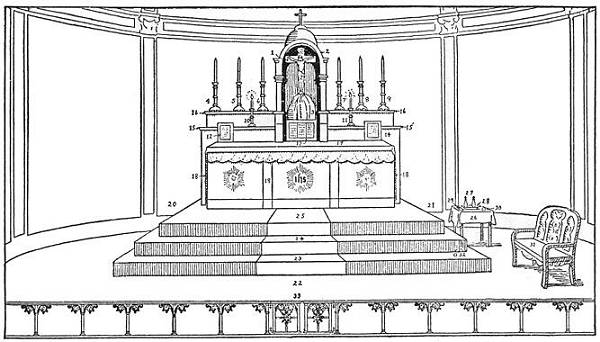
There then begun a battle over what it meant to be a Catholic. The innovations went to the very soul
of Catholicism. How could it not affect or 'shatter' Catholic souls or
the faith of these souls? These were a group of people who simply
refused to believe that the 'progressive' movement known for visibly hacking the Altar from the gradine of the Church on a global scale was wise or even the logical fruit of Vatican II.
The radical movement 'forward' (a rallying cry of many a communist)
left people behind because the raptured architects and rupturous
builders of it forgot that as much as God calls us to go forward does He call us to turn back to Him. That is what repentance is. It means to return, to turn around, to the Lord, not to turn to the future, not to turn to ourselves, not to turn to one another, but Ad Deum.So back to 'the split'. Foley says...
'I think what happened was this. The leaders of the Church - priests, brothers, nuns - divided into two groups without realising it. One group became very interested in reading all that the theologians and Bible schoilars had to say about the Church today, religion today. They went to meetings, conventions lectures etc. They had a great time discussing the beautiful (to them) developments. And as ideas developed, they got them gradually. Over a period of 10 -15 years, they had absorbed many new ideas. If they - or again, let me stay with my experience - if I, for instance were to compare my awareness, outlook, ideas in 1970 with those I had in 1960 without any experience of the years between I would have been very surprised at myself.
On the other hand, other traditional leaders in the Church - priests, brothers and nuns - had an instinctive feeling that something was wrong, dangerous, about the new emphases. Some were so busy they had no time for reading and study. In any case, for many reasons, they did not have the same experiences as those described above. And so, rightly or wrongly, they were, say in 1970, as far away from some of their fellow priests, brothers and nuns as I was from my 1960 self. Many of the laity divided in the same way. But it seems that the majority not accustomed to different opinions in the Church were, and simply are, confused, scandalised and unhappy.'
In other words, not only were some so moved by their 'experiences' that they began to see the Church's leap forward as progress, but priests ordained before the Second Vatican Council who disagreed with the changes were divided from those who saw within its implementation an improvement on the Church of yesteryear. Not only this, but priests ordained before the Council, by 1976 saw themselves, their ministry and the Catholic Faith they adhered to in a radically different way seemingly divorced from that which they had hitherto known. Yet...yet, the answer that this was due to the different 'experiences' of priests is flawed because of the simple fact that those who wept over the changes imposed on the Catholic Church (and who faithfully stayed) lived in the same time, experienced the time and the culture, but simply held onto that which their generation had held as sacred! The author continues...
'For a while it seemed that the breath of fresh air in the Church was being enthusiastically inhaled by one and all. Popular speakers, the Catholic press in general exuded euphoria, glowed with euphoria. But apparently the explanation didn't take with lots of people. Some of them came to adult [re-]education classes (most did not) and were seldom convinced of the wisdom of the "new" approach. People's native caution, the whole emotional atmosphere in which they were raised, the obvious mistakes that were made in some cases, made people feel that "they" were tampering with the foundations and there was danger that the whole building would fall down.'
Addressing the concerns At this point, you can't help wondering whether Fr Leonard is either in denial of the reality the Church faced and still faces, or whether he believes in the way the Council was implemented, or whether he is just being loyal and obedient to those who implemented it. You can almost hear him crying on the inside...
'Recently, I have had some experiences that have helped me appreciate how the "old" Church feels. Just as some of my old friends are appalled by guitar Masses, bouncy music and "togetherness" at Mass, so I am scared out of the ball park by the exuberance and expressiveness of the new "charismatics". I know they are holy, Spirit-filled people. I know they are bringing in thousands of people, especially younger ones, to a new experience of Christ (I should say Jesus). But their emotional expressiveness appals my cold Irish-German temperament, their zeal to get me "in" turns me off, and their rhetoric irritates me. I finally know how my cousin Eileen feels about A Mighty Fortress is Our God ("Damned Protestant hymns!" she mutters, charging out of church).
So I have some sense of how traditional Catholics feel, even though I would probably be considered a fuzzy liberal by some of my Franciscan confreres (and an outdated square by others).
So, was faith destroyed by the changes?
'People with a strong faith - whether they buy the new approach or not - seem to be able to handle the confusion. Faith for them is simply a giving on oneself to God [...] Words and rituals may change, but my faith stands beyond these things.'
'Faith is inside. It is caught, not taught. It is lived, not memorized. It is a divine spark, not a human creation. It can no more be destroyed from without than the God whose presence it reveals. Now if faith is this inner indestructible reality, external problems, confusion and change should be relatively easy to handle.'
Okay, so what about
those people whose faith cannot withstand the Catholic Church issuing a
category five hurricane on its members? Unfortunately, Fr Leonard
doesn't answer that question. In other words, a 'good' Christian, a
faithful disciple accepts the changes with a face of flint and goes
along with it, even if he or she can't stand it. The 'good' Christian
doesn't leave. Fine, but what happens to all those men and women without the personal faith of St Monica and for whom the Church was a Rock, entirely dependable and unchanging in Her character? What of those who get the general
impression the Church doesn't stand for what it stood for, no longer
exists for what it existed for and has had its true mission, as well as
its most missionary and constant signpost - the Mass of Ages - relegated to a dusty archive somewhere in the walls of the Vatican? No answer. On top of this we now know that if you really want to destroy Faith, you can do so by allowing the infiltration of the Church by pederasts who abuse the Church's children and destroy not just the faith of those children, but the faith of many others by covering the whole thing up.Is it not the case that by the time that this book was promulgated, having received an Imprimatur from the then Archbishop, later Cardinal Joseph F. Bernardin, that the damage had already been done and that those who remained faithful to the Church out of love were 'strong' enough to cope with seeing and hearing the Holy Sacrifice of the Mass being turned around and often turned into a Eucharistic circus while priests ad-libbed the Mass in the vernacular and stopped talking about sin, salvation, heaven, hell, purgatory and all the things mentioned by Our Lady at Fatima?
Words of Advice
In a way St Monica is a good illustration of the loving mother who patiently waits for her own prodigal son, St Augustine, to return to the true Faith, entangled as he was, in so many sins, heresies and dominated by so many passions contrary to it. Ironically, that is how the Church stands today. Our Lady, meanwhile, truly is the Mother of the Church who implores her children to come home, to repent, to love her Divine Son.
At Fatima her advice was clear: 'Pray, do penance, make sacrifices for sinners', 'wear the Scapular' and the Miraculous Medal, live the Faith, pray the Little Office, convert sinners, 'pray the rosary', work for the salvation of souls, go to Confession regularly, receive the Blessed Sacrament for what it truly is, the Body and Blood of the Lord, stop offending God, do good and avoid evil, for He is already too much offended. These are all part and parcel of the message of Fatima. This is Catholicism.
The advice of Fr Leonard writing in 1976 is to 'remember the mixed-up Church is still Jesus's visible body', 'go for the genuine people', look for sound teaching and buy a copy of the Vatican II documents, 'don't leave your parish church' and 'don't let your faith be overcome by bitterness'.
What strikingly different messages and words of advice these are. Compare the words of the Churchman and the words of the Mother of our Saviour. I am convinced that the enduring power of the vision of Fatima lays not just in the simplicity of Our Lady's words, told as they were to simple shepherd children, but the strikingly supernatural and miraculous nature of the Fatima event. In an age in which even in the highest ranks of the Catholic Church, the supernatural, Divine and vertical is downplayed and the earthly, human and horizontal is emphasised, Fatima endures in the hearts of many Catholics, as does Lourdes and other sites of Marian devotion and pilgrimage. It is no wonder that sites like Medugorje and Garabandal attract so many pilgrims despite a lack of official Church approval. Could it be because at a time when the Church has stopped talking of Divine things, things that speak to the soul of our need for salvation, that there remains within modern man and woman a thirst for the supernatural, for clarity, for doctrine, for timeless truth that they struggle to find within the parish Churches?
The question that remains for those from the 1970s to the present day who tried so hard to assuage the fears, anxieties and confusion of those who, regardless of whether the Church believes their faith was 'shattered', either left the Church or neglected to teach it to their children, who went on to become men and women without faith, is this: When will you accept, like St Augustine of Hippo, that it is never too late for the Church to turn around 180 degrees, for its hierarchy, its bishops, cardinals, priests and even the pope, to reject that which damages faith, which causes confusion, especially in the liturgy in which Catholics gather to worship and praise God? For, as we know from the Friars of the Immaculate, those who embrace what those who came before us embraced are no longer met with soothing words, but suspicion, derision and the abuse of the ecclesiastical law in the process of their forceful restriction.
It is never too late to turn back...to the Lord
It took so many prayers and tears of a loving mother for Augustine to accept that he was in the wrong, that he was just a man, that beside God there are no other gods, that He alone could save him and turn him into the man who would one day say, at the end of every homily, 'Let us turn to the Lord'. After the 1960s, the Catholic Church turned its back on well over 1500 years of Her holy traditions, with fatal consequences for Her life, mission and the souls in Her care. Many priests, many friars, some Cardinals and some Bishops have realised that folly of leaving the sacred behind in purusing a horizontal vision of the Church that so often ultimately leads to the denial or a misrepresentation of all that the Magisterium of the Church still holds to be true concerning Salvation.
Has change shattered our faith? That is really not the right question. A more apt question is this: What kind of a father, or guardian, would risk shattering the faith of his children? In answering that question, you will know whether the dramatic upheavals and changes executed in the wake of the Second Vatican Council documented within this post were from God, the Eternal Father, or not. Because Pope Benedict XVI declared the Mass of Ages to be 'never formally abrogated' Priests, Bishops and Cardinals, as 'Fathers in God' to the flocks entrusted to them, should surely ask that question, rather than just going 'forward' blindly, heedless of the appeals of the Mother of God made at Fatima for purity of Faith, and, having asked that question, should surely act accordingly. To priests, to Cardinals, to Bishops: It is never too late. It is never too late, to turn back - not back in time, but out of time, out of space, turn back, back Ad Deum, to God who gives joy, once more, to your youth.
Bank Holiday Book Reviews
A few years ago, I discovered Lord of the World, by Msgr. Robert Hugh Benson. This book is becoming a book with a cult following. I want to highlight that one and None Other Gods, a lesser known, but worthy read.
I grew up with Benson's books on my parents' bookshelves, as my paternal grandfather was an Anglophile, and we had Benson, Evelyn Waugh, P.G. Wodehouse, and many other great authors virtually staring down on me from those shelves when I was toddling around with a sippy cup.
I remember my grandfather's old legal bookcases, the ones with the glass doors and wooden knobs. He died when I was very young, but his heritage of reading, as well as that gift of culture from the real intellectuals on my mother's side, inculcated in me a love of good literature as well as the treasuring of religious books.
Benson's books in early days were all in hardbound, but when I was an adolescent, these began to appear in paperback, with gaudy, Hollywood-esque covers. How could a young person not be captivated by Come Rack! Come Rope!, The Queen's Tragedy, The King's Achievement or Oddsfish with technicolor drawings on the front, like those horrible Barbara Cartland love stories?
I was a Mary, not a Martha in those days, and my mother had to take books away from me in the long summer holidays and put them on top of the fridge, which I could not reach, in order to get me to do my chores first.
Benson's world was England, which became my world, as I sat on the white and purple pansied, cotton, ruffled coverlet draped over my bed in my girly room, (after I had finished daily chores), devouring tales which included Edmund Campion making a début, courageous women in flowing gowns hiding priests in secret, small spaces behind wainscoting, and courtly scenes of intrigue surrounding a romantic, dying king.
At that time, in the hot summer days of steamy Iowa, the windows in my room were bombarded by the stupid, giant June bugs hitting against the screens of those windows which overlooked the front garden, a view complete with tall red and silver maple trees, so still in the heat; red spiky flowers which attracted the hummingbirds; and sprinklers emitting a soft chug-chug sound, while spraying arcs of water over the lawn. But, my imagination reached far away to dark grey, treacherous, 16th century London; the Tudor-manicured green, rural English landscapes in which nestled the great Catholic recusant houses; and terrifying Tyburn.
Two books seem to me, however, to be written more for adults than for dewy-eyed twelve-year-old girls. These are Lord of the World and None Other Gods. I want to recommend these now.
Lord of the World, a science fiction novel, is simply, prophetic. The fact that it was written in 1907 astounds one, as the milieu created is absolutely contemporary to us now. I shall not drop spoilers for those who have not read it, but I read it three times in 30 months a few years ago. I may read it again soon. And, Benson's writing remains a standard for us all.
Of course, I am known for re-reading great books, having read Little Dorrit, Middlemarch, Daniel Deronda, Great Expectations, Barchester Towers, Till We Have Faces, etc. too many times to remember the exact count, and this does not include all the Austen books I have read umpteen times, or others on my favourite list. I have book binges on Benson, Austen, Eliot, Thackeray, Trollope, and Dickens regularly. The longer the books, the better, but Benson wrote comparatively short novels, so one can read these quickly.
The second book to be emphasized in this post is None Other Gods. This odd tale, written in 1911, actually explained the life of St. Benedict Labre to me, that mysterious "Fool for Christ", better than any commentary of his life possibly could.
The tale, which does not appeal to some, as it seems too improbable, reveals a journey towards holiness which I found stunning. Again, I read it awhile ago, twice, in a twelve month period, and I am reading it again.
Benson understood men and women as flesh, blood, and spirit. His people are not anaemic. Through his characters, his stories reveal the Incarnation of Christ affecting the decisions of various men and women, and the role of the Church Militant, tales all composed in accessible sentences. He understood the hard road to holiness, to spiritual perfection, be it for Charles II or Mary Tudor, or Frank, the main character in the second book highlighted.
This summer is almost over, but if some of you still have a holiday, think of taking Benson's books to the beach or mountains or your reading corner. Search for them on Google and you'll find these two are even online.
I grew up with Benson's books on my parents' bookshelves, as my paternal grandfather was an Anglophile, and we had Benson, Evelyn Waugh, P.G. Wodehouse, and many other great authors virtually staring down on me from those shelves when I was toddling around with a sippy cup.
I remember my grandfather's old legal bookcases, the ones with the glass doors and wooden knobs. He died when I was very young, but his heritage of reading, as well as that gift of culture from the real intellectuals on my mother's side, inculcated in me a love of good literature as well as the treasuring of religious books.
Benson's books in early days were all in hardbound, but when I was an adolescent, these began to appear in paperback, with gaudy, Hollywood-esque covers. How could a young person not be captivated by Come Rack! Come Rope!, The Queen's Tragedy, The King's Achievement or Oddsfish with technicolor drawings on the front, like those horrible Barbara Cartland love stories?
I was a Mary, not a Martha in those days, and my mother had to take books away from me in the long summer holidays and put them on top of the fridge, which I could not reach, in order to get me to do my chores first.
Benson's world was England, which became my world, as I sat on the white and purple pansied, cotton, ruffled coverlet draped over my bed in my girly room, (after I had finished daily chores), devouring tales which included Edmund Campion making a début, courageous women in flowing gowns hiding priests in secret, small spaces behind wainscoting, and courtly scenes of intrigue surrounding a romantic, dying king.
At that time, in the hot summer days of steamy Iowa, the windows in my room were bombarded by the stupid, giant June bugs hitting against the screens of those windows which overlooked the front garden, a view complete with tall red and silver maple trees, so still in the heat; red spiky flowers which attracted the hummingbirds; and sprinklers emitting a soft chug-chug sound, while spraying arcs of water over the lawn. But, my imagination reached far away to dark grey, treacherous, 16th century London; the Tudor-manicured green, rural English landscapes in which nestled the great Catholic recusant houses; and terrifying Tyburn.
Two books seem to me, however, to be written more for adults than for dewy-eyed twelve-year-old girls. These are Lord of the World and None Other Gods. I want to recommend these now.
Lord of the World, a science fiction novel, is simply, prophetic. The fact that it was written in 1907 astounds one, as the milieu created is absolutely contemporary to us now. I shall not drop spoilers for those who have not read it, but I read it three times in 30 months a few years ago. I may read it again soon. And, Benson's writing remains a standard for us all.
Of course, I am known for re-reading great books, having read Little Dorrit, Middlemarch, Daniel Deronda, Great Expectations, Barchester Towers, Till We Have Faces, etc. too many times to remember the exact count, and this does not include all the Austen books I have read umpteen times, or others on my favourite list. I have book binges on Benson, Austen, Eliot, Thackeray, Trollope, and Dickens regularly. The longer the books, the better, but Benson wrote comparatively short novels, so one can read these quickly.
| Mgr Robert Hugh Benson |
The tale, which does not appeal to some, as it seems too improbable, reveals a journey towards holiness which I found stunning. Again, I read it awhile ago, twice, in a twelve month period, and I am reading it again.
Benson understood men and women as flesh, blood, and spirit. His people are not anaemic. Through his characters, his stories reveal the Incarnation of Christ affecting the decisions of various men and women, and the role of the Church Militant, tales all composed in accessible sentences. He understood the hard road to holiness, to spiritual perfection, be it for Charles II or Mary Tudor, or Frank, the main character in the second book highlighted.
This summer is almost over, but if some of you still have a holiday, think of taking Benson's books to the beach or mountains or your reading corner. Search for them on Google and you'll find these two are even online.
Sunday, 25 August 2013
Rethinking The New Evangelization
![]() |
| St Augustine of Hippo |
Too often, evangelization either is too banal, that is, watered down to the lowest common denominator; or it is an attempt to bring people out of serious sin by attacking the sins; or it is the speaking of Jesus as Saviour again outside of context of the larger perspective of what is means to be human and what it means to know a particular God.
I have been thinking about St. Augustine and his importance to our Catholic world today. He wrote in a similar time-the great destruction of a civilization which had endured for hundreds of years. He also bought a philosophical approach to all that chaos.
The Hebrews experienced much the same situation over and over and over. Either they were destroying old civilizations, or their own was being destroyed by whatever conqueror was the most powerful.
The reason for my ruminations is that we need, desperately, Catholic minds which can stop addressing the moral questions, stop addressing the ethical questions, and go back further to the basic questions of the existence of God and the nature of what it is to be human.
![]() |
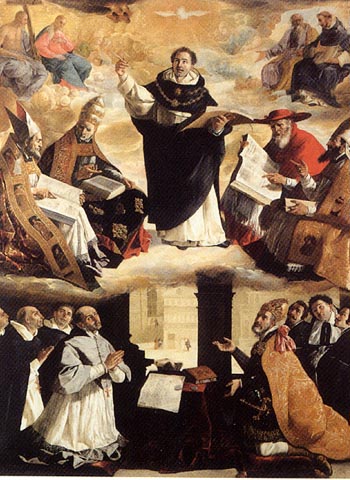
| St Thomas Aquinas |
There are few great Catholic minds which can address the basic questions youth ask today. Here are a few of those questions.
Is there a God?
What would be the meaning of being human?
What is the relationship between men and God?
Why are we here?
Do you ever doubt?
Why do you want to be a Catholic?
Augustine wrote his City of God in direct response to pagans, agnostics, and even atheists who were blaming Catholics for the fall of Rome. Hey, folks, this will happen again and I do not see the bright spark, a new Augustine, who can address the entire question of the nature of man, the City of God and the secular city in terms of basic principles. Phenomenology is too personalistic for this discussion. We need to revisit the Greeks, the Romans, all part of our heritage. We need to go back to the basics, or we shall continue to lose yet another generation.
Apologetics has been so slanted towards ethics, towards morality, that it has set aside the first principles. As humans and as Catholics, we must be able to discuss metaphysics at this level. Aristotle, Aquinas, the neo-Thomists, even educators, such as Montessori, all of whom are part of my mindset, my history, used the scientific method of rational discourse.
This is no longer accepted by many, and we cannot meet physicists, politicians, academics of any kind with language they no longer accept.
We must go back further. And, I do not mean Duns Scotus, who was more popular than Aquinas for a very long time. Nominalism is limited as well. We must go back and ask the basic questions of believing, of the supernatural, of God Himself. We must evangelize at this level, and not merely the moral or ethical one.
Those Millennials who ask the basic questions have no framework for morality because they have no philosophical framework. Benedict, the Pope Emeritus, was the man of the time, reminding us that Augustine was not only a theologian, but a philosopher. We need to look at him again in that light, and at those Doctors of the Church who helped the Church develop doctrine from the basic principles.
The reason we must think in different terms is that we are witnessing the chaos of the death of Western Civilization and to speak in any terms purely from moral or ethical viewpoints will not speak to the hearts of those completely at a loss, at sea in chaos.
That is what the Moslems do - speak only in ideological, so-called moral terms. This type of approach does not speak to the very essence of who a person is and who God is. Imposing law without the reasons for such begs the question of religion.
I read and hear too many high-ranking priests, bishops, theologians, especially moral theologians, who do not have the proper perspective of the problem of basic principles, because their own training was so limited. Try and find excellent philosophers in seminaries who are orthodox and can engage at this level of thinking.
When one answers the questions of who man is and Who God is, then the moral and ethical questions fall into place.
I hope God raises up some great metaphysical minds in this era. I hope and pray that both clergy and laity can learn to evangelize from basic principles.
Friday, 23 August 2013
Sisters of the Blessed Virgin Mary Move to Permanent Home
The new religious community of the Personal Ordinariate, the Sisters of the Blessed Virgin Mary, have a permanent home for the first time since they were received into the full communion of the Catholic Church on New Year’s Day. They are to move on Tuesday (August 27) into a convent in Birmingham which is the former home of the Little Sisters of the Assumption.
Mother Winsome, the Superior of the Sisters of the Blessed Virgin Mary, said: “We are absolutely overjoyed to have been given the opportunity to live in this convent. We have prayed long and hard and the Lord has opened up this way for us. It is a gift from God.”
The community, established as part of the Personal Ordinariate of Our Lady of Walsingham adopting the Benedictine rule, includes eleven sisters who had been part of the Anglican Community of St Mary the Virgin in Wantage Oxfordshire and one, Sister Carolyne Joseph, who belonged to an Anglican community in Walsingham.
With no endowments to keep them afloat financially, the sisters have been living for the last eight months as guests at an enclosed Benedictine abbey on the Isle of Wight. “The abbess and the community there shared their Benedictine life with us and welcomed us into their hearts in the most wonderfully generous way”, Mother Winsome said. “It has been a life of complete harmony and joy and it will be a wrench to leave. But we are pleased beyond measure that our journey of faith has taken this new direction”.
The provision of Benedictine hospitality through retreats is central to the community’s charism. Their intention is to earn a living at their new home by offering retreats and the ministry of spiritual direction.
Subscribe to:
Posts (Atom)