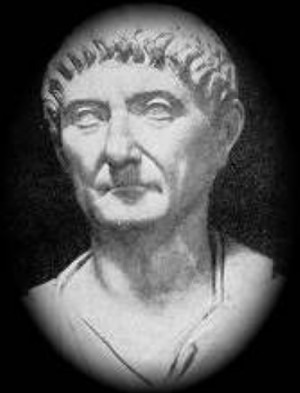
Showing posts with label persecution. Show all posts

Friday, 11 September 2015

February 24, 303 Revisited XIII


The Romans had done persecutions before. What was the difference? Diocletian helped calm down the stress of financial difficulties.

He increased taxes, built up the army, made it into a military state which were all things that worked before.

What was the difference which caused the persecution of the Catholics?

Two things caused the hatred of the Catholics-first, the stress of the people being on the edge of the decline of the civilization.

Second, the return to rejuvenate the glory that was Rome was based on a conservatism, of a system which was outdated, as the new system emerging was feudalism, which was local government, a new idea, as the empire idea was passe.

Rome was twice the size of the old USSR. The empire model was ending fast, the imperial system was old and weary, whereas the local systems were growing.

The Senate was made up of local Roman families, not world travelers, like the emperors or the army.

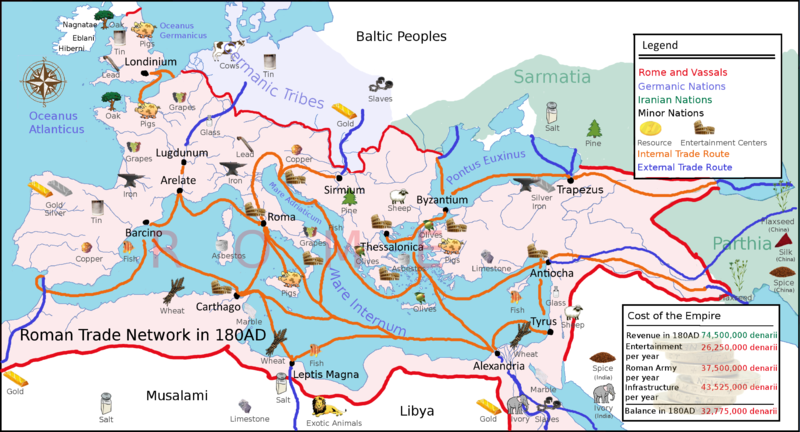
CC BY-SA 3.0 File:Europe 180 ad roman trade map.png Uploaded by Adhavoc Created: 27 September 2010

Rome was reliant on the supply lines, corn from Egypt, and other far in distance, trade routes. Over-centralization of bureaucracy and over reliance on imports killed Rome-Rome could not re-invent itself.

A city like Rome has never existed since then, never. A real center of politics, technology, trade, it was increasingly reliant on charismatic leaders like Diocletian. The inside was crumbling. Therefore, a scapegoat had to be found.

DOES THIS SOUND FAMILIAR?

Stress is now in the West. I see it and I feel it. 

The Catholics.........the Catholics became the scapegoats as the largest minority group. They were at least 20% to 30% of the population. They were seen as a threat to the old common good.

There were many Catholics in the military. And, they could command armies, and even become emperor.

They were THE threat to the world order; a huge system which was NOT pagan threatened the system.

Yes! We are on the edge now, dear readers.

It has all happened before.....

Catholicism could not be adopted by the pagans, as other cults were. Catholicism could not be put into the melting pot. Catholics were not eclectic or gnostic. They were and are real focused people in a real world. Their Church is bigger than any empire, nation, country, city, area.

And the separation of church and state is ending in countries which have had this, as the states will create a religion of secularism.

Are you getting ready? (Originally written and published in February, 2014)

Thursday, 10 September 2015

February 24, 303 Revisited XII


What most people do not know, because the history of Western Civilization stopped being taught in most high schools in the 1980s, is that Diocletian came into power with an agenda because of the serious economic problems preceding his reign. This man knew who to organize. He knew how to push the envelope in order to save Rome.

He did something which may happen again in the States and in the EU. Because the Romans were no longer taking over new lands and bringing back slaves, there was a shortage of workers. (Does this sound familiar now, with abortion and contraception?)

He made, through law, a serfdom, by taking away the small farmers civil rights and tying them to their land. This created the coloni underclass who farmed the land and paid rent to the owner. This rent was either money, part of the harvest or more labor.

Many people were forced into becoming coloni. At the same time, the trade of Rome was dropping. If one could compare the times with today, one could say that Wall Street collapsed. The difference was that the emperor sought reforms by taxation and an emphasis on control of personal freedom and rights.

This may happen. This can happen. That the Great Persecution was part of the overall plan of renewal meant that it was accepted both as necessary for the continuance of the empire and the lifestyles of the empire, and as a necessity for the return of the "true Rome."

Inflation caused the Roman currency to drop. Here is a chart of early "quantitative easing".


And here is a detailed description of Diocletian's monetary reforms.

The reforms of Diocletian (284-305 CE) completed the recovery. He again tried to issue a new stable gold and silver coinage but, more importantly, he revised and regularized the tax system with some revolutionary new concepts. First he conducted a census of the Empire and divided everything into two types of tax units based on productive capabilities. These were land units called “iugera” and head count or “capita” (and yes, that’s where our modern term “per capita” comes from).
These were flexible units which took into account the different productive capacities of various types of land and the different productive capabilities of men, women, slaves and children. For instance, adult men were each calculated as one capito or one head count, but it took two women to make up the same amount of head (and I’m going to bite my tongue before I take a straight line like that any further!) and even larger numbers of children.
The greatest innovation was the concept of Capitatio. What this meant was that the state has the right to demand whatever it needs from its citizens in whatever form it wants provided it is done legally and correctly… as follows…
Each year on September 1st, the state’s total requirements were published and taxes would be apportioned to each province according to its assessed resources. In effect, what Diocletian had created was the modern idea of a national budget and tax system. Though the burden was undoubtedly heavy, it was at least equally assessed in all areas.
So efficient was this new system that the money seemed to pour into government coffers like it hadn’t in memory. No longer did the citizenry suffer the regular experience of being treated like conquered territory by armed men who were supposed to be their protectors. People’s iuga and capita were known to them in advance, tax receipts could prove what they had paid, and appeal could be made if collectors tried to abuse them. http://www.accla.org/actaaccla/kramer.html

Diocletian the financial saviour became Diocletian the moral saviour by killing those whose god was not Rome. 

All we need is one crisis, folks. One.....................To be continued......

Wednesday, 9 September 2015

February 24, 303 Revisited XI


In the times of the Great Persecution, the Roman army was re-organized to become even more faithful to the emperor.

The financial life of the empire was re-organized with new taxes.

Family life was "renewed" with the revival of the cult of the gods of Olympus.

One must stop and say that on the outside  
these ideas looked good to the public who thirsted for renewal.

But, what was the problem with Rome on the "inside"? What levels of evil lurked under the reorganization of a great people?

There is only one evil which informed all the great evils which led to and which sustained the Great Persecution. 

And that one evil is idolatry.

Once a people idolizes their own civilization more than God, the end of that people is near.

The one thing which the early Church had as the priority was that there was only One God in Three Divine Persons to be loved and worshiped. All else, like community and sharing,  came from this focal point.

But, dear readers, one must practice this denial of sin and the denial of the will daily.

Do you think the early Catholics lived in nice times?

This persecution we see commonly now is the world in which they lived. Catholics need to prepare for more.

The inside eventually becomes the outside--the dead souls eventually take over the lands once led by those who were trying to be good, trying to be holy.

Idolatry is the great sin of this age.

Only those who worship the one true God, the Trinitarian God can stand up against such evil.

Are you getting ready?

A reader asked me for another story, another fantasy to help all understand the times: here it is.

The "Villa of the Vineyards" was the talk of the city. Builders and artisans worked day by day restoring the old Pudens mansion on the southern side of the urbs. A modern Celer ordered slaves and freemen in the cold air of February, taking advantage of the lack of rain.

The closest neighbors to the owners of the delle Vignacce, as the locals called it, was the family of the famous Julia Claudia Paulina Severini, a branch which had escaped the purges of later emperors beginning the Crisis of the Third Century. The great-grandchildren of the Severini lived in the Villa del Ave, a smaller, less grandiose version of delle Vingacce, but grand none the less.

This family had welcomed the Tetrarchy, but now regretted that their favourite, Diocletian, had turned against the Catholics.

This large family had relatives in Ostia, an uncle who owned ships and a shipping yard. And, Sabina, the matriarch of the Villa del Ave, had a brother, who was a priest, serving the bishop at Basilica of Santa Aurea.

Sabina opened a letter sent via servants. She was at breakfast with her husband, Maximus, and adult children, Flavia and Lupus. Flavia was engaged to the Catholic Lucas, who lived in Rhegium, of another shipping family. Lucas and Flavia were to be married in June.

"This letter was written yesterday, the 23rd, Maximus, and is from my brother Claudius. He writes that by the time I read this letter, the bishop will have been either arrested or in hiding. He suggests we go to Ostia and take a ship as soon as possible to avoid today's decree. The bishop had been warned by a Catholic member of the emperor's household."

Maximus put down his spoon. He was eating a fruit compote mixed with honey and seeds. Maximus had digestive problems and could not eat the meat that Flavia and Lupus were "scarfing down".

"It will not be as bad as people think it will be, Sabina. I am not moving. I cannot leave the men who are chafing at the complete destruction of the senate by this tyrant. We want to try and convince the other emperors to re-instate our power. I mean, it is a time of change."

Sabina looked sorrowfully at her husband. She knew that he, like so many others in their church, did not think that the citizens of Rome would cooperate with the slaughter of Catholics.

If Ostia was dangerous, even leaving on one of their own ships could be too obvious and too dangerous.

But, Sabina knew the real reason for Maximus' reticent to talk about the coming persecution. His elderly parents lived only a mile away and he would not leave Fabius and Domitilla, who would be too old and too stubborn to move. Sabina ate a pear.

"I think I should change the wedding date, pushing it up to late February. We could do that, Mater, could we not?"

Sabina smiled sadly. "I think it would be a good idea, but your Father determines this, Flavia."

"No, we are not changing anything. I cannot believe my good pagan friends would rise up against us or any of the ancient families. I just do not believe this."

Sabina stood up. "Come, Flavia, you and I have work to do with the poor baskets." The Mater could see tears clouding the young woman's eyes and wanted to speak with her privately. The two women left the room to Maximus and Lupus.

"Pater, are we allowed by Christ and the Church to fight? I am ready." Maximus looked at his son. He loved Lupus more than anyone else, and the name of the family would be carried down in his blood.

"Yes, remember what the bishop said at Mass. We have a right to defend ourselves. We do not have to be blind sheep. But, it most likely will not come to that."

Lupus knew that was the end of the conversation. He bowed to his father and left to find Sabina and Flavia. He wanted to reassure them of his protection.

In the house of Fabius and Domitilla, another conversation was taking place. Domitilla's old brother, Aelius, was trying to convince the old couple to leave.

"You do not understand the powerful rhetoric of this Diocletian. In the name of Roman virtues, he begins to kill the Catholics. No one will be safe."

Fabius answered with a bang of his fist on the table. "No, it will not happen. There are too many Catholics hidden in the military. They will not arrest their own. You will see a rebellion."

Aelius stared at his plate of vegetables and meat. The cook at this house was famous throughout Rome.

"Someone might envy you your cook, Fabius."

"And, I do not want you talking to your sister about these things. You frighten her."

Aelius jumped in, "Yes, I want her to be scared, and you as well. You think your wealth and status will protect you. The Bishop of Ostia is in hiding and the Bishop of Antioch is already missing. My servants brought me word this morning, as I have contacts."

Aelius continued..."And our other sister Amelia, has already left for a frontier town where her son is a governor. You know the place."

Fabius stood up, "Enough. I am not going to Limes Germanicu because of scare-mongering. I trust the people of Rome. Now, good day, Aelius."

Fabius left in a huff. Domitilla poured water for her brother. "Dear Aelius, I agree with you, but I must be loyal to Fabius. You understand."

Aelius put his hand on the old hand of his younger sister. "I am afraid for you both, Domitilla. If you want me to stay, I shall but I plan to go with Amelia."

"Go with my blessing, Aelius. I can say no more."

The two separated forever. Aelius and Amelia went to Germany and died there in a small community of Catholics. In Rome, the situation escalated quickly. Within the month, all the Catholic nobility were sent letters from Diocletian offering them amnesty if they sacrificed to the gods of Olympus. In April, the lower class areas were being "cleansed" of Catholics. By May 1st, the villas of Fabius and Maximus were confiscated by the government and the inhabitants arrested.

Fabius, Domitilla, Maximus, Sabina and Lupus were executed by sword. Their Catholic servants died in the Colosseum. Lupus had helped Flavia leave in the night before the arrests. She and Lucas travelled to Mauretania Caesariensis, one of the newly re-organized provinces of the Dioecesis Africae. They had many children and thrived as a family until the entire family but one, perished in the Muslim take-over and establishment of Maghreb. That one, Maximus the Tenth of that name, sailed to the land of the Angles and married a local girl, who was of the great, prosperous family in Bignor.

Perhaps one of their descendants is today crossing a street in Arundel and perhaps his name is Maxim. Perhaps, he is a Catholic.

to be continued.............

Tuesday, 8 September 2015

February 24, 303 Revisited X


Diocletian retired and left his empire's laws against the Catholics on the books. In fact, after he abdicated on May 1, 305, some of the provinces saw less persecution. However, in the eastern one, under Galerius and Maximian, the horrors of torture and death continued until 313, with some persecutions happening even after the Edict of Milan Edictum Mediolanense. Maximian hated the Catholics particularly.

But, the persecution did end, only to be taken up again later by others. Here is a section of the Edict.

When you see that this has been granted to [Christians] by us, your Worship will know that we have also conceded to other religions the right of open and free observance of their worship for the sake of the peace of our times, that each one may have the free opportunity to worship as he pleases; this regulation is made that we may not seem to detract from any dignity of any religion.
—"Edict of Milan", Lactantius, On the Deaths of the Persecutors (De Mortibus Persecutorum), ch. 48. opera, ed. 0. F. Fritzsche, II, p 288 sq. (Bibl Patr. Ecc. Lat.XI).[8]

But, for those of us on this side of the persecution, that is, those of us who are watching the ratcheting up of forces being put into place to either make Catholics scapegoats, or merely to constrict them severely, the coming days of fines, imprisonment and even death are yet to come.

We have time to prepare in four areas:

1) Find that truth in ourselves, that cell with God to know what it is he wants you to do and where to go. If you are married with children, this means praying about the entire family. Fathers need to take the lead in these discernments and actions.

2) We have time to seek the perfection of the virtues necessary for the evil times. There will be many suicides and apostates. We must be in a good place spiritually ourselves, not to be tempted to despair, and to be able to help others.

3) This is the last call for building communities. Travel will be restricted or very expensive. Movements will not be free.

4) Children must be prepared to be little soldiers for Christ. Parents need to pray how this is to be done. Children are called to be saints as well as adults.

Notice how I have said nothing about the clergy or the sacraments. The laity need to be prepared not to have either priests or the sacraments. 

Time to grow up and think and live like Catholics.

Monday, 7 September 2015

February 24, 303 Revisited IX


This is my dream, fantasy conversation. Imagine a beautiful room with a fountain and pool. Imagine good food, and wine.served in a newly decorated  triclinium in the villa of Aetius, who is married to the beautiful Paula. They has two young sons. Aurelius, Aetius, Gaius, and Lucius are sitting at cena, talking about the latest news concerning the February 24, 303 law.

The wives are in the culina, with the maids, getting more wine for the evening's conversation. These women, Paula, Rufina, Valeria and Vita talk. Valeria has put the children to bed for the night in her house with trusted slaves in another part of the city. Paula's children have just gone to bed. Now, these women are wondering at the news concerning the new law.

They had all been to the basilica in the morning for mass and prayed there.

In fact, the priest, Justin, promised he would come for the evening, but he had not.

Aetius sent out two Catholic servants to find out what is happening.

The men discuss these points. Will they be safe as part of the upper classes? Will their Catholic servants be safe? What of their children?

What of their families in other cities, like Antioch, Mediolanum, even Cordova? Should these family members be warned, or will they find out soon enough the news of the horrible new edict?

The women join the men just as one of the servants of Justin comes through the door. Justiin, the priest, has been arrested and is prison. He will be forced to worship the gods of Olympus, or be killed.

Silence covers the room, like dread.

Then, Gaius speaks first. "I shall take my family to Cordova, where my brother has a business. We shall see what happens there. I shall not wait and watch my household divided. We have discussed this before today."

Valeria, his wife, puts her hand on his arm and leaves the room. She moves quickly, and crosses Rome with a servant to their house. She is ready. She has seen the signs of the times. She will gather her five children, and be gone as soon as possible. Her parents live in Mediolanum. She has talked with them before, but they would not listen. They cannot believe the Roman people would allow their Catholic friends to be killed. Perhaps her parents are right, but she must think of her children.

Two will become priests. 


Lucius and Rufina are a young couple. They have no children. But, they have a country house. Lucius asks the men if they think the area of Tivoli would be safe. No one is sure. The villa may be too close to Rome.


Aurelius and Vita are the oldest couple. Their children, all Catholics, are gone, living in Antioch, and in Massalia. Would Massalia be safe? Their son is a government official in that city. 


The men decide to make plans to leave now, except for Lucius, who believes he and his wife will be safe in Tivoli, at least for now.


But, the servant, Albinus, shares that he heard a rumor that even the Pontiff, the Pope, would not be safe in the countryside. Indeed, in one short year, Pope Marcellinus would be martyred, on April 1st, 304, and finally buried in the Cemetery of Priscilla, the Via Salaria, on April 26th.


The men become silent. Then, Gaius suggests they pray, and read the Scriptures, as he has a copy with him of the Gospel of Mark. He is a rich man and had a copy made for his household, and for the church.


He reads this: erunt enim dies illi tribulationes tales quales non fuerunt ab initio creaturae quam condidit Deus usque nunc neque fient, Mark 13:19.


Gaius and Valeria, their five children, and all their servants disappear during the night to Cordova. They leave most of their things. They know that some Catholics have already been killed in Seville. They will avoid that city. They leave by cart, and then by ship. Gaius makes sure he is carrying the Gospel of Mark with him. He takes only gold and what they need for the journey.

Albinus, the servant, leaves with Aetius and his wife, Paula, and two young sons within days. No one sees them leave. No one knows where they went. Their surname is still alive centuries later-Macinus, Macini.

Lucius and Rufina decide to go to Tivoli to their country estate. They invite Aurelius and his wife to stop on the way. No one stays in Rome.  By six o'clock the following morning, Aurelius and Vita are on their way to their son in Massalia with two trusted slaves. They prayed and decided not to stop in Tivoli. They will contact their daughters in Antioch when they are settled in Massalia.

But, these are the ones who talked about such a day in the recent past in their lives.

These are the ones who passed the Faith on to their children. These are the ones who had an "exit strategy".

To be continued.....

Sunday, 6 September 2015

Febraury 24, 303 Revisited VIII


A reminder in this series that the Great Persecution occurred throughout the entire Roman Empire. Europe, the Middle Eastern provinces, Africa, including Egypt, all saw the imposition of the laws against Catholics.

The great cathedrals were destroyed, such as the one in Nicomedia.

The attitude of the Catholics would have been one of watchfulness and prayer. The maximum number killed as determined by historians is set at 5,000.

One of the most familiar martyrs of this time is St. Agnes.

She was young, very young. So, she was prepared for the trial she had to endure.

Living in a society where one is bound to be persecuted clarifies the mind and intentions.

Moderns think that the Catholics at the time of the Great Persecution were all slaves. Not so, but some were, and some were from all the classes. These included the highly educated and people of the urbs. No one was spared because of position or rank. We know that the Church spread throughout the continents because of the Christian diaspora.

But, what is important for today is to realize that God has a plan. And, Catholics must not be complacent.

They can plan as well. It is important to remember that when one faces death or imprisonment, we are not assured that we shall persevere to the end. We need to pray for final perseverance.

That is my prayer.

And, here is St. Francis Liguori's prayer for final perseverance.

Eternal Father, I Humbly Adore and Thank You, for having Created me, and for having Redeemed me. I Thank You for having made me a Christian, by giving me the True Faith, and for Adopting me as Your Child in Baptism. I Thank You for having given me Time-to Repent, after my many Sins, and for having Pardoned all my Offenses. I Renew my Sorrow for them, because I have Displeased You. I Thank You also for having Preserved me from Falling-again, as I would have done, if You had not Held me up, and Saved me. But my Enemies, do not cease Fighting-against me, nor will they, until I Die. If You do not Help me Continually, I will Lose Your Grace again. I, therefore, Pray-for Perseverance till Death. Your Son Jesus, has Promised that You will give us whatever we Ask-for in His Name. By the Merits-of Jesus Christ, I beg You, for myself and for all those who are in Your Grace, the Grace-of Never-more being Separated-from Your Love. May we always Love You in this Life, and in the Next.
Mary, Mother of God, Pray to Jesus for me. So I Hope. So may it be.
Amen

To be continued.............

Saturday, 5 September 2015

February 24, 303 Revisited VII


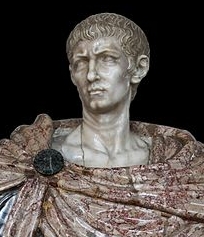
Diocletian was seen as a "saviour", a reformer of good, old fashioned Roman values. He was successful in targeting a few groups which were increasingly seen as threatening the empire.

The empire and the gods were one. The emperors and the gods were one. Security and peace, low inflation and financial progress were the priorities.

The Roman household had a strong identity. They were proudly "Roman". Could one be a Catholic and a Roman? Sound familiar?

He decided that instead of emperor, he would be called Dominus Noster. One can see immediately that his intent was to consolidate power, even propagandist power, under his rule. Some historians claim that Galerius, one of the four emperors in the Tetrarchy, really pushed for the Great Persecution but the fact is that it started and was overseen by Diocletian.

All rulers want to make a mark on history. That Diocletian reorganize Roman life and finances, even down to creating hereditary jobs, made him popular. The scene for persecution was set by a determined group who put the Roman Empire before the one, true God.

The Dominus Noster fought the Domino Dominorum. Today, we call this impetus narcissism.


Therefore, in the empire built on law, the Catholics became a group under watch, under suspicion for being "not quite Roman". (Not quite British, not quite American?). The Romans had a highly successful civilization. They took pride in their history and accomplishments.

Would they let a growing group which included foreigners to take over their cultural norms? They saw themselves as virtuous against other barbarians. But, here was a group which refused to buy into the whole deal of complete loyalty to the state in the person of the emperor.

Perhaps the Catholics were seen as "racists", as "anti-Roman" by their neighbors. These attitudes have all been seen before and enshrined in law before. To have loyalties beyond the empire and emperor at such times became a rallying cry for persecution. How does a remnant respond? Once the clergy were imprisoned, killed or dispersed, what options would the remnant have? Few, but some.

The first characteristic of such Catholics who persevered would be the four cardinal virtues of prudence, temperance, justice, and courage. In other words, personal holiness kept those in the remnant from compromise. The second characteristic would have been mutual support in the face of danger. In other words, a quiet, low-key community.

The third characteristic would have been the readiness to face whatever suffering came their way. Actions and beliefs have consequences beyond the grave, and this the early Catholics knew well. A mind-set of readiness is essential in persecution.

Watch ye therefore, because ye know not what hour your Lord will come. Matthew 24:42. DR

This readiness would not be confined to adults. The necessity of the times meant that parents had to prepare their children for imprisonment, loss, death. Too many Catholics want to protect their children from such thoughts. They do so at the peril of their children's lives. The readiness is all, as Hamlet states, but rather ironically. We take the words seriously to heart.


Not a whit. We defy augury. There’s a special providence in the fall of a sparrow. If it be now, ’tis not to come. If it be not to come, it will be now. If it be not now, yet it will come—the readiness is all. Since no man of aught he leaves knows, what is ’t to leave betimes? Let be. Act V: scene ii.

To be continued....

Friday, 4 September 2015

February 24, 303 Revisited VI


With the ruins of the churches in Rome and in all the provinces, in the cities and in the countryside, with the destruction of the Scriptures and libraries of the cathedrals and basilicas, came a loss which would have impacted the daily lives of the Christians.

No longer would they have easy access to the sacramental life of the Church. By the end of 303, the clergy would have been imprisoned or scattered. Some would have melted into the houses of the laity. Some would have left the areas for safety, like the Seminary Priests during the Protestant Revolt in England.

That the clergy went underground is obvious for one reason-the Faith survived. In some places, as the
persecution intensified (and, remember, it was empire-wide), entire congregations would disappear. Parishes and dioceses would disappear forever. Not one of the churches mentioned in the Book of Revelation survived.

Sometimes, it is easier to hide in a very large city. Sometimes, it is easier to hide in the country.

We know from the history of the liturgy, that the Mass was at first in the cities in the cathedrals and was
high mass. We know that the low mass came about because of the dispersal of the Catholics from the urban areas into the countryside.

Smaller, unknown churches with simplified rubrics became the order of the day. We also know that the catacombs, the ancient tombs of Rome, were used for mass.*

The catacombs would have been implemented for burials only until the end of the fourth century, when Catholics were free to bury their dead above ground.

But, in the time of Diocletian, the catacombs would have been places for mass. So, from the third to the end of the fourth centuries, these underground places provided safe havens for worship, not for living.

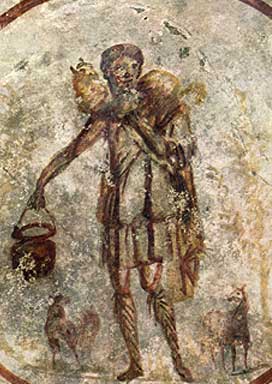
Thanks to wiki for photo of The Good 
Shepherd from S. Callisto catacomb.
Many of the new martyrs were buried in the older tomb areas.

However, in our day and age, such places of safety will be more and more rare. With the great intrusiveness of privacy, less and less communities will be isolated. But, the world is a very big planet, and the remnant will be small. To think there will be no safe havens is not realistic, but to pretend there will be many is also unrealistic.

That the remnant may consist of less numbers than what we could imagine is a strong possibility. But, as in all times of persecution, those who can get away from the worst areas of hatred will be those who have a plan.

I know two people who escaped the Nazi take over of Czechoslovakia. They managed to get out because they either obeyed a parent who told them to go, now, (the teen woman), or they skillfully planned an escape (the teen man).

They both made it to England, fell in love there, and finally traveled to Canada, where they lived most of their long lives.

The woman in this couple had a sister who did not escape. She did not obey her father's warning to "leave now".

She was never found. Years, ago, I myself tried to help the woman locate her sister, but we had to give up. We could not find a trace of her after that sad day.


The use of common sense and the use of discernment can make a difference between life and death.

Some Catholics would have left Rome and gone into country areas, away from the towns and cities where the arrest of Catholics would be easiest. They would not have gone alone. There would have been "safe houses" as in England in the 15th and 16th centuries.

The spread of Christianity partly was owing to the dispersal of the Roman citizens across Europe.

This type of movement may happen again, but with a difference. However, people would have to be willing to be displaced, to move, to leave all, for the sake of the Gospel being handed down to the next generation.

Like the forever missing sister, some who refused to flee died. Some did not have a choice, as they were arrested. But, some survived.

Therefore, one must adopt a flexible attitude of being alert. One must help establish safe houses. One must be willing to sacrifice all.

(*Thanks to Father Michael G. Nevin in a series of talks at St. Kevin's, Dublin Latin Mass Chaplaincy, for notes on the history of the liturgy in early Rome.)

To be continued....

Monday, 31 August 2015

February 24, 303 Revisited II

from  Mosiacarum et Romanarum Legum Collatio 6.4, qtd. and tr. in Clarke, 649; Barnes,Constantine and Eusebius

19–20.

"...the immortal gods themselves will favour and be at peace with the Roman name...if we have seen to it that all subject to our rule entirely lead a pious, religious, peaceable and chaste life in every respect"

The first thing to understand about the Great Persecution is that it was not only legal, but religious. The national religion of the empire was being renewed by Diocletian and co-emperors,


MaximianGalerius and Constantius, for the good of the empire. The financial and military good of the empire 
meant that the old gods of Olympus had to be appeased. In the face of difficult times, it was necessary for the citizens to worship the "true" gods of the empire. In a sense, Diocletian and his fellow emperors in the Tetrarchy 
were revitalizing the entire Roman world with a new sense of dedication to the old gods.

So, why would the Catholics be the particular subjects of persecution?  (For the record, the Manicheans were also persecuted.)

The answer is obvious today. Any group of people which shows an allegiance to something other than the 
totalitarian heads of state form a threat. And, any group of people which holds beliefs contrary to those of the totalitarian state is a threat.

The problem with too many Catholics today, is that they do not see themselves as a threat to the growing totalitarianism of both the EU and America, now both run by anti-Christian principles, and increasingly 
anti-Catholic values or ideals.

Too many Catholics honestly believe that they can "talk", or have detente, with the growing evil of the world.

This prevailing attitude can only lead to an increase in self-deceit and a false hope for change.


Small battles have been won here and there, but the battle for souls is being hindered by communism, socialism, secularism, and neo-paganism. It really does not matter, at this time, what "ism" will push through the draconian 
laws, as it only takes one.

We have all seen this before under Henry VIII, Elizabeth I, and Mao, among others.

The Catholics are the threat, always, as our kingdom is not of this world.

So, the stage is being set, quickly, very quickly for a new February 24, 303.

To be continued....
Related Posts Plugin for WordPress, Blogger...